
Pipe Repurposing Project Delivers Asset Recovery and Carbon Savings
Salvex, a global marketplace specializing in asset recovery and surplus inventory, recently completed a pipe repurposing project for Eni that generated both financial returns and measurable environmental benefits.
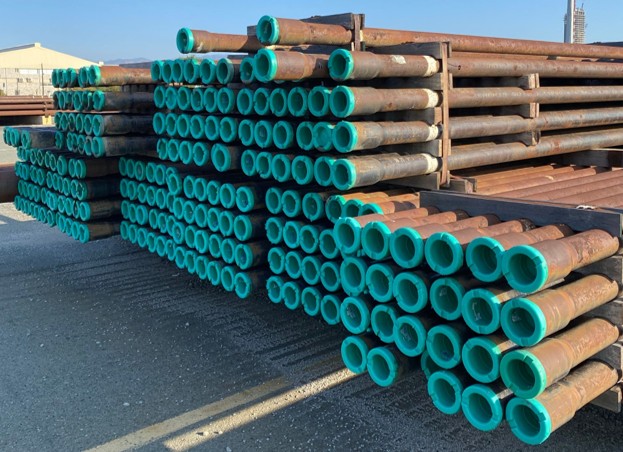
As Eni's oil and gas activities in Cyprus wound down, the company identified approximately 2,128 metric tons (t) of unused casing and line pipe in various sizes and conditions that had never been allocated to previous projects (FIG. 1). Before classifying the inventory as surplus, Eni first evaluated whether the materials could be redeployed elsewhere within the company's operations.
Once it was determined the inventory was no longer needed internally, Salvex developed a recovery strategy to remarket the material.
Because the inventory included multiple pipe sizes and specifications, the project required identifying several end-use markets. Salvex assembled a project team from Houston, London and the country of Georgia to coordinate the effort and meet the required export schedule from Cyprus.
Potential buyers were identified across piling, fencing and oil and gas applications where the materials could be reused without requiring new manufacturing. Salvex ultimately secured buyers that could immediately utilize the pipe while providing fair market value for the inventory.
The project enabled Eni to recover value from surplus assets while supplying materials to customers facing immediate demand.
In addition to the financial recovery, the project generated an estimated 4,064 metric t of carbon offsets through manufacturing avoidance, while eliminating the need to extract new raw materials.
The effort also freed valuable storage space and reduced the environmental impact associated with manufacturing replacement pipe.
FIG. 2 illustrates the environmental benefits of the repurposing strategy. Manufacturing new steel pipe through traditional mining and blast furnace production typically generates approximately 2 tCO₂e–2.5 tCO₂e per metric ton of steel produced.
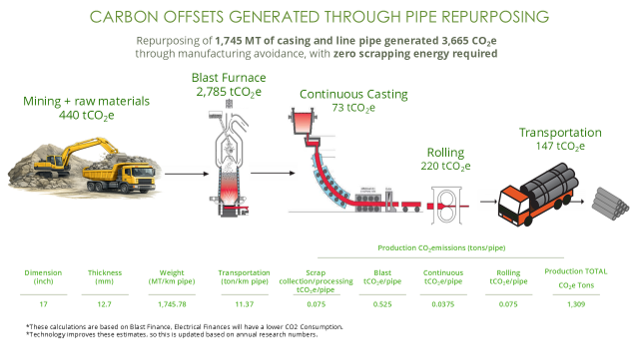
Although producing steel from recycled scrap in electric arc furnaces reduces emissions to roughly 0.4 tCO₂e–1 tCO₂e per metric ton, repurposing existing pipe remains the lowest-emissions option because it requires little more than transportation and limited cutting or preparation.
According to Salvex, the project avoided approximately 3,665 metric t of CO₂e that otherwise would have been generated through manufacturing. That reduction is roughly equivalent to the annual carbon emissions produced by 262 average Americans, based on approximately 14 tCO₂e per person each year.
While these avoided emissions are classified as Scope 3 emissions and do not generate tradable carbon offset or renewable energy credits, they still represent meaningful environmental benefits and demonstrate how asset recovery strategies can contribute to broader sustainability objectives.