
How Pipe-in-Pipe Systems Improve Leak Detection and Pipeline Reliability
J. MOUGEL, ITP Interpipe, Houston, Texas (U.S.)
The equivalent of 16 liquified natural gas (LNG)–34 LNG carriers is 1.25 million metric tons (MMt)–2.66 MMt, which represents the estimated annual methane leakage from U.S. pipelines, according to a 2024 Environmental Defense Fund (EDF) study. These leaks create both environmental and safety concerns. Methane (CH₄) is 80 times more powerful than carbon dioxide (CO₂) at trapping heat in the atmosphere over a 20-yr period, and leaks can be especially hazardous when pipelines are installed in dense industrial areas or near populated locations. In addition, leaks generate economic losses for pipeline operators. Of course, this issue is not restricted to CH₄ and applies to all forms of pipeline transport.
By design, pipe-in-pipe systems can provide secondary containment. However, an important question remains: how can leaks be efficiently detected before they become more serious issues? Even without leaks, how can operators ensure that a pipeline will operate safely throughout its entire service life while complying with both safety requirements and specified thermal efficiency, even after several decades of use?
This article details how the pipe-in-pipe solution developed by the author’s company addresses these challenges while ensuring safe and reliable operation.
Simple by Design
The three elements necessary to achieve one of the lowest thermal conductivity levels on the market for pipelines are an inner pipe, outer pipe and insulation material.
The inner pipe serves as the carrier for the fluid. By selecting the appropriate material—from the standard low-temperature carbon steel to the low-coefficient of thermal expansion (CTE) nickel alloys—the author’s company ensures that the pipeline will operate safely throughout its entire lifetime. Depending on the application and the client’s needs, the inner pipe can be either an off-the-shelf standard product or a custom-made solution.
At the core of the system lies its key component: the insulation material. Unlike conventional insulation materials (e.g., polyurethane foam or aerogels), the material used here can achieve industry-leading thermal performance with thicknesses typically ranging from 5 millimeter (mm)–60 mm. Not only is its thermal performance exceptional, but it also offers strong mechanical properties. This enables the system to eliminate intermediate support elements that would otherwise complicate fabrication and reduce thermal performance. Finally, the insulation material is non-aging.
The outer pipe, an integral part of the design, not only protects the insulation and the annular space but also balances the thermally induced stresses in the inner pipe caused by the fluid temperature. Consequently, the system eliminates the need for expansion loops typically used in cryogenic pipelines. This provides direct installation advantages by reducing the pipeline footprint and potentially eliminating the need for trestle or jetty structures.
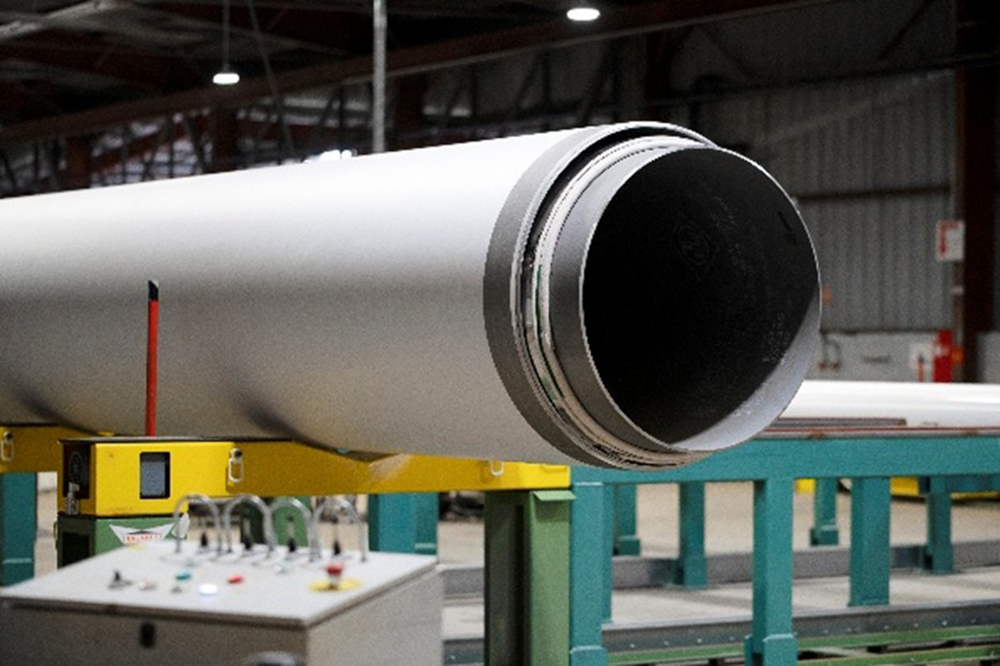
A simpler route also improves operational efficiency by lowering pressure drop and, therefore, reducing the energy required to move the fluid. By designing custom insulation for each project, the lowest possible outer diameter can be selected, ensuring a compact and cost-efficient solution for procurement and installation (FIG. 1).
Not All Routes Are Straight
When working in highly congested areas, the author’s company’s technology is applicable not only to straight joints, but also to bends and branch connections. In addition, these elements are designed using the same principles as a standard pipe-in-pipe system: an inner section carrying the fluid, a thin high-performance insulation layer and an outer pipe.
There are no centralizers and no mechanical connections between the inner and outer pipes, resulting in no thermal bridges.
Minimum Footprint, Maximum Performance
The author’s company’s technology delivers high-standard thermal performance—generally around 0.1 watts per square meter Kelvin (W/m²K)—while maintaining a compact design, with the outer pipe being only around 6 in. larger in diameter than the inner pipe.
Needing no expansion loops nor expansion joints, the author’s company’s solution can also be fully buried, including in trenched and horizontal directional drilling (HDD) sections. Building on its simple and robust architecture, the system integrates maintenance and leak detection strategies as core functions across all installation configurations.
PIPE-IN-PIPE MAINTENANCE
More Convenient Than a Vacuum-Insulated Pipeline (VIP) Solution
In addition to being compact and reducing installation costs, the author’s company’s solution operates at reduced pressure, or soft vacuum conditions. From a maintenance perspective, this represents a key advantage compared to systems based on vacuumed annulus technology operating under deep vacuum conditions to maintain thermal performance. In those systems, even minor degassing can significantly affect thermal performance, and corrective actions may require the installation of powerful vacuum equipment.
VIP solutions generally present a discontinuous annular space. In case of a leak on one joint, excavation is needed to connect the pump. The continuous annulus used in the author’s company’s solution reduces the number of branch connections, providing two key advantages: a lower risk of leakage, and simplified access to the annular space through one or both branches located at the extremities of the line.
A Steady and Predictable Performance
Relying on its unique insulation material, the solution ensures that the system’s thermal performance remains stable over time while maintaining very low maintenance costs. Thanks to its mechanical properties, the insulation material can support the weight of the inner pipe without requiring regular supports that would otherwise degrade overall and localized thermal performance.
The material can also accommodate small displacements between the inner and outer pipes without affecting its thermal properties. Most importantly, the absence of outgassing elements within the annular space, combined with the solution’s low sensibility to pressure variations compared to VIP solutions, is key to maintaining consistent performance.
This allows operators to more accurately anticipate long-term operating costs, which is a critical factor for projects expected to remain operational for more than 30 yrs.
A Mechanically Sound Design
The selection of materials for both inner and outer pipes is of paramount importance in preventing failure and minimizing maintenance requirements. By using materials that retain ductile properties even at cryogenic temperatures, limiting displacement and maintaining stress within a low-range, safe long-term operation can be ensured.
The outer pipe, generally designed to withstand the pressure of the inner pipe, also acts as a protective shield for the insulation against the surrounding environment.
Due to the annulus section operating at reduced pressure in an almost moisture-free environment, corrosion under insulation (CUI) is no longer a threat that requires frequent inspection and repair. Cathodic protection and coating applied to the external surface of the outer pipe reinforce this protection.
Simplicity is the key to the system’s durability with an inner pipe carrying the fluid, a high load-bearing insulation material and an outer pipe. Simple in design yet with robust components, the technology addresses maintenance concerns from the very beginning. Combined with top-tier thermal performance, it enables operators to operate pipelines at lower costs for decades.
LEAK DETECTION
Continuous Annulus
The author’s company’s design consists of a continuous annulus, unlike typical pipe-in-pipe solutions where the annulus is discontinuous and each section requires its own detector. This feature simplifies the implementation of annulus pressure-based leak detection because only one or two pressure sensors—located at the extremities of the line—are needed to cover the entire system.
Easy and Robust Detection
Like the pipe-in-pipe design itself, the primary leak detection approach is simple. There is no need for cables within the annulus or for multiple instruments distributed along the line. Pressure sensors, which are easily accessible at the extremities of the line and interface directly with the global control system, are sufficient to detect leaks.
Positioning sensors only at the extremities also simplifies maintenance in case of malfunction, since accessing sensors located in HDD, trenched or even above-ground sections can be complex.
Whether the pipeline is installed above ground or buried, the author’s company can provide clients with accurate information to help establish alarm thresholds and estimate the extent of a leak.
Thanks to its low-pressure annulus, the system has a low detection threshold, enabling leaks as small as approximately 5 milliliters (ml) per second to be detected in a matter of minutes.
Depending on the length of the pipeline and leak rate, detection time can, in some cases, be reduced to only a few seconds. This rapid detection capability is made possible by maintaining annulus pressure below the liquid-to-gas transition pressure. As a result, leaking liquified gas evaporates almost instantly, creating overpressure within the annulus.
Early Detection to Precise Location
Pressure-based leak detection enables rapid leak detection, but one parameter remains unknown: the exact location of the leak. While detecting the presence of a leak is critical for safe pipeline operation, accurately locating it is essential for enabling fast and efficient repairs.
This is where the fiber optic distributed temperature sensing (FO DTS) system becomes valuable. Lying adjacent to the pipe-in-pipe system, a fiber optic cable provides operators with a clear temperature profile along the entire pipeline. It functions like having a temperature sensor every few feet without requiring extensive associated instrumentation.
In addition, the system is immune to electromagnetic interference and can safely operate in environments containing flammable materials or high-voltage equipment.
In case of an inner pipe breach, the temperature of the outer pipe will locally decrease, highlighting the leak’s location. Because the detection is mainly based on local thermal gradient, it is not dependent on ambient temperature or the relative position of the fiber optic cable to the pipeline or coating thickness (FIG. 2).
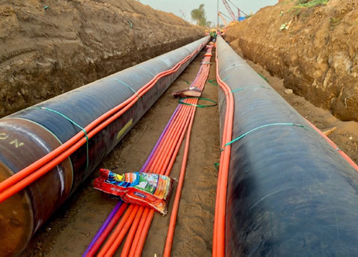
While visual examination for leaks is difficult and time-consuming for buried pipelines, the fiber optic cable provides a clear picture of the temperature along the line. In addition, for accessible above-ground pipeline, the FO DTS remains a powerful solution thanks to its capacity to instantly capture the temperature and its evolution in time—it can take hours to visually inspect a several miles-long pipeline.
Similarly to the primary leak detection system, the FO DTS is continually monitoring the pipeline without interruption. This two-level approach of leak detection, based on robust, field-proven technologies, ensures quick and accurate leak detection.
Field Application
For more than 30 yrs, the author’s company’s technology has been used globally for projects ranging from cryogenic to high temperature, carrying LNG, liquified petroleum gas (LPG), ammonia (NH₃), bitumen, gas and condensates.
In 2017, the company built the first fully buried cryogenic pipeline, and a similar LNG project, including trenched and HDD sections, is now being installed in the U.S., providing full double containment.
Offshore Applications
Similar configurations to the one presented in this article are also used in offshore environments where pipe-in-pipes can be installed using the reel-lay method or pulled from the mainland.
As an example, the author’s company designed, procured, constructed and installed one of the world’s hottest subsea pipelines in 2020. The experience gained from such projects, in harsh environments and with high installation stresses, benefit all complementary applications.
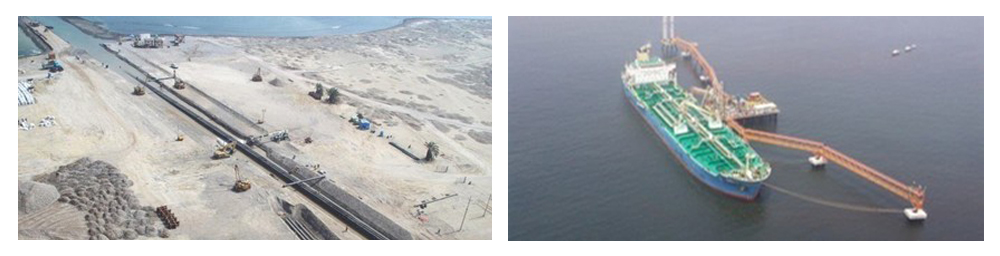
One remarkable implementation is an LPG pipeline used to feed an offshore mooring berth, avoiding the construction of a conventional trestle jetty. This pipeline experienced a magnitude 8 earthquake without suffering any damage (FIG. 3).
Future Development
One of the author’s company’s current developments is its technology’s adaptation to liquified hydrogen transportation requirements. Despite the challenges, the final objective remains the same: keep the system as simple as possible. This is the most efficient method to provide a low-maintenance solution with the highest safety standards and the best thermal performance.
About the Author
JULIEN MOUGEL joined ITP in 2022 after several years in the aeronautics industry. As a project engineer, Mougel has contributed to multiple projects, with various scopes of work. He began his ITP journey by spending a year at the company’s Normandy workshop and yard, supporting method engineering for the manufacture of pipe-in-pipe systems and welded assemblies.
Mougel then moved to ITP’s Paris headquarters, where he led scopes including procurement engineering, production management and support to fabrication and field installation. Mougel recently joined ITP’s Houston, Texas (U.S.) office, where he leverages this experience to support project development, engineering and execution across the Americas.