
Robotic Phased Array Ultrasonic Inspection for Unpiggable Offshore Pipelines
M. GINTEN, ROSEN Group, Lingen, Germany; R. BAUERNSCHMITT, ROSEN Group, Mannheim, Germany; N. GRUHLER, ROSEN Group, Karlsruhe, Germany; and B. KOSTER, ROSEN Group, Lingen, Germany
A growing share of offshore pipelines today fall outside the reach of conventional in-line inspection (ILI). Rigid risers, steel catenary risers (SCRs) and loading lines are often classified as unpiggable due to their configuration, operational constraints or limited accessibility. Concurrently, these assets are among the most fatigue-critical elements in offshore production and export systems.
Risers are continuously exposed to motion induced by waves, currents and vessels, resulting in high levels of cyclic loading over their service life. Fatigue damage, particularly at girth welds and other areas where stress is concentrated, represents a primary integrity threat. Although modern designs incorporate advanced fatigue analysis and safety factors, inspection remains essential to validate assumptions, detect early-stage cracking and support risk-informed integrity management. Where assets are close to reaching or have exceeded their design lives, many operators have initiated lifetime extension initiatives, for which superior inspection data is imperative.
However, inspecting these types of pipelines presents a fundamental challenge: conventional free-swimming ILI tools are frequently unsuitable or cannot deliver the resolution required to characterize fatigue cracking in complex weld geometries. This has driven increased interest in robotic inspection technologies combined with advanced ultrasonic techniques that can provide high-resolution data in pipelines that were previously considered unpiggable.
This article describes a robotic phased array ultrasonic testing (PAUT) inspection concept designed specifically for such applications. The approach combines cable-operated robotic deployment with full matrix capture (FMC) and adaptive total focusing method (TFM) imaging to enable the detailed inspection of girth welds and pipe body areas in offshore pipelines that cannot be inspected using conventional methods.
Fatigue Cracking in Unpiggable Offshore Pipelines
As depicted in FIG. 1, fatigue in offshore pipelines is strongly associated with cyclic loading and localized stress concentration.¹˒² Cyclic stresses in risers and loading lines are induced by environmental forces and operational activities, such as production, offloading or tanker motions. Over time, these repeated stress cycles lead to the gradual initiation and growth of cracks.
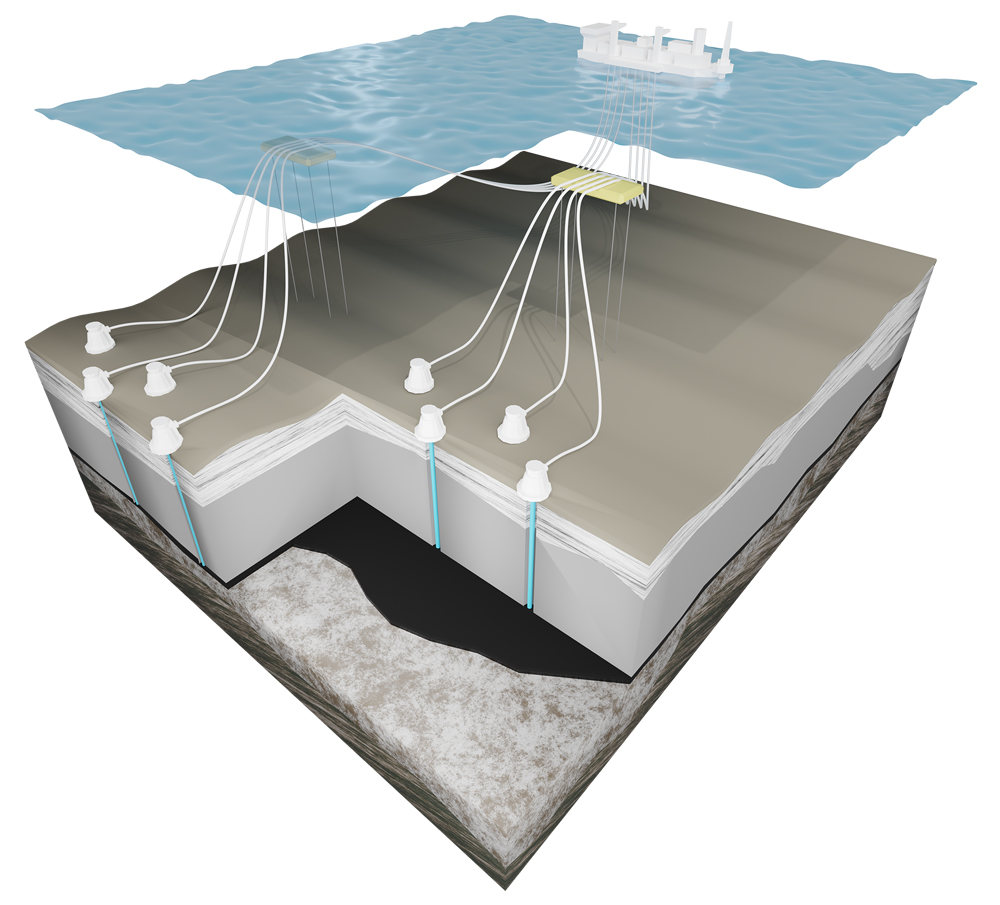
Girth welds are particularly susceptible. Local geometric transitions, residual welding stresses and variations in material properties within the heat-affected zone increase fatigue sensitivity. Manufacturing imperfections, such as porosity, lack of fusion or weld toe undercut, can further elevate stress concentration. In seawater environments, corrosion-fatigue interactions may accelerate crack growth once cracking has initiated.
Accurately assessing the integrity of these assets requires more than simply detecting cracks. An engineering critical assessment (ECA) and remaining life calculations depend on reliable information about the type, depth, orientation and position of defects within the weld or base material. In many unpiggable pipelines, existing inspection approaches struggle to provide this level of detail, resulting in conservative assumptions, limited confidence in fitness-for-service evaluations and premature intervention decisions.
The Role of Robotic ILI in Unpiggable Pipelines
Robotic ILI systems offer an alternative method of inspecting pipelines that cannot be accessed using conventional pigs. Rather than relying on product flow for propulsion, robotic tools use crawler mechanisms and are deployed via a tether. The tether supplies power, enables real-time data transmission and allows for precise control of the tools’ movement from the surface (FIG. 2).
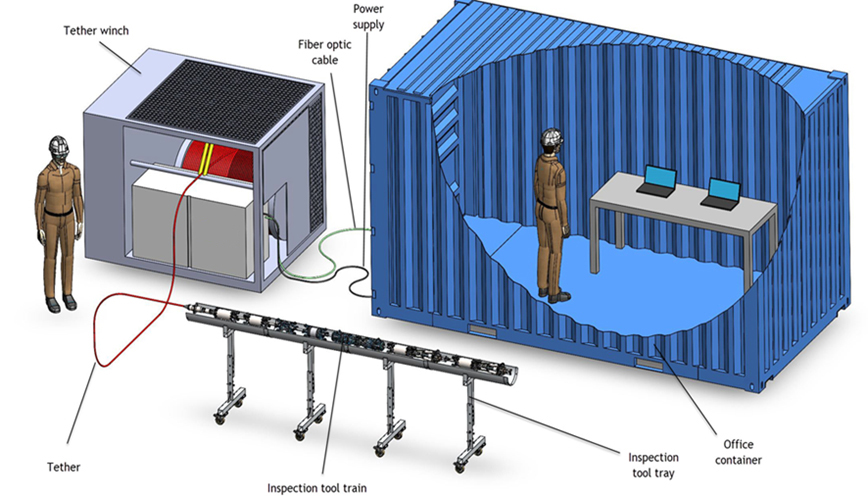
This deployment concept is particularly suited for offshore pipelines with limited length, complex profiles or challenging entry conditions. Robotic systems are equally important and can stop at areas of interest (e.g., girth welds) and perform detailed, localized inspections. This capability is essential for ultrasonic techniques that benefit from high data density and controlled scanning conditions.³˒⁴
For risers and loading lines, robotic ILI bridges a critical inspection gap. It enables the internal inspection of assets that would otherwise be restricted to external visual inspection or indirect monitoring methods. Neither of these methods provides direct information about the condition of internal welds or crack morphology.
PAUT with FMC
The inspection concept described here combines robotic deployment and PAUT using FMC technology. A dedicated sensor carrier equipped with multiple phased array probes is positioned inside a liquid-filled pipeline. The probes are arranged to cover the pipe body and girth weld areas.
In FMC, each ultrasonic element transmits a pulse sequentially while all elements receive the returning signals. The result is a complete dataset containing all transmitter-receiver combinations. While computationally demanding, FMC preserves the full ultrasonic response of the inspected volume and forms the foundation for advanced imaging techniques.
During inspection, the sensor head moves circumferentially along the girth weld. High-spatial-resolution data is acquired, enabling a detailed reconstruction of weld geometry and defect features. Acoustic coupling is achieved through the liquid inside the pipeline, enabling non-contact immersion testing. This configuration removes the need for wedges or direct probe-to-metal contact, and significantly improves robustness in the presence of irregular weld profiles or surface conditions.
Adaptive Total Focusing Method for Complex Weld Geometry
The TFM is applied to transform FMC data into interpretable images. The TFM synthetically focuses the ultrasonic response at every point in the area of interest to reconstruct an image. All relevant sound paths are considered and their contributions are summed coherently, resulting in high-resolution images with improved defect detectability.
Girth welds often have complex internal and external geometries. Standard imaging assumptions are often insufficient under these conditions. To address this issue, an adaptive TFM approach is employed.
The internal pipe surface is identified directly from the ultrasonic data by reconstructing an image of the liquid region containing the metal surface. This surface model is continuously updated and incorporated into the imaging process. Additionally, the back-wall geometry is determined to enable accurate modeling of reflections and mode-converted sound paths.
Different wave modes—namely longitudinal and shear waves—are evaluated simultaneously. Data from different probe positions and propagation paths are combined into a concise set of high-fidelity images representing the full weld and pipe wall structure. This adaptive reconstruction is essential to reliably generate images of fatigue cracks located near weld toes, in heat-affected zones or within irregular weld geometries.⁵
Data Processing and Defect Characterization
The adaptive TFM imaging process is based on extracting the geometry of the internal surface, as well as the back wall. These interface models are then used to calculate the precise time-of-flight paths of all ultrasonic signals. Ultrasound images of the metal structure are then created based on the selected wave modes and the number of internal reflections. The final output is a comprehensive image set that includes the weld geometry and potential defect indications.
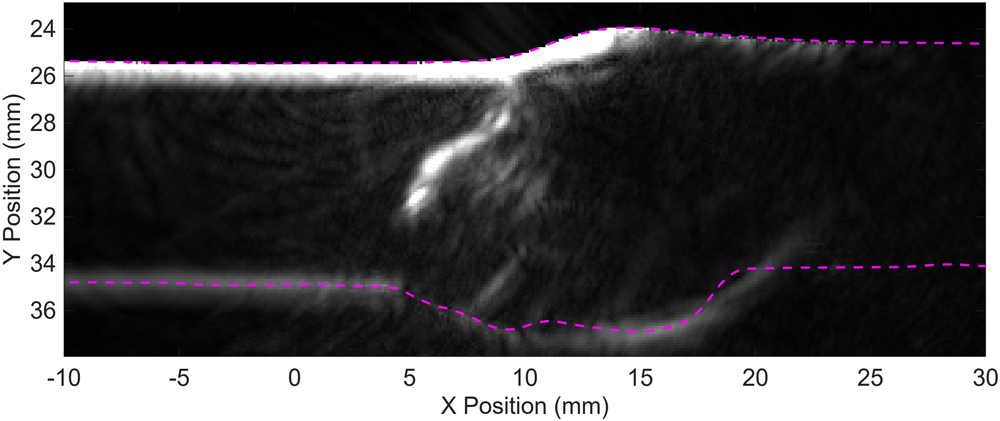
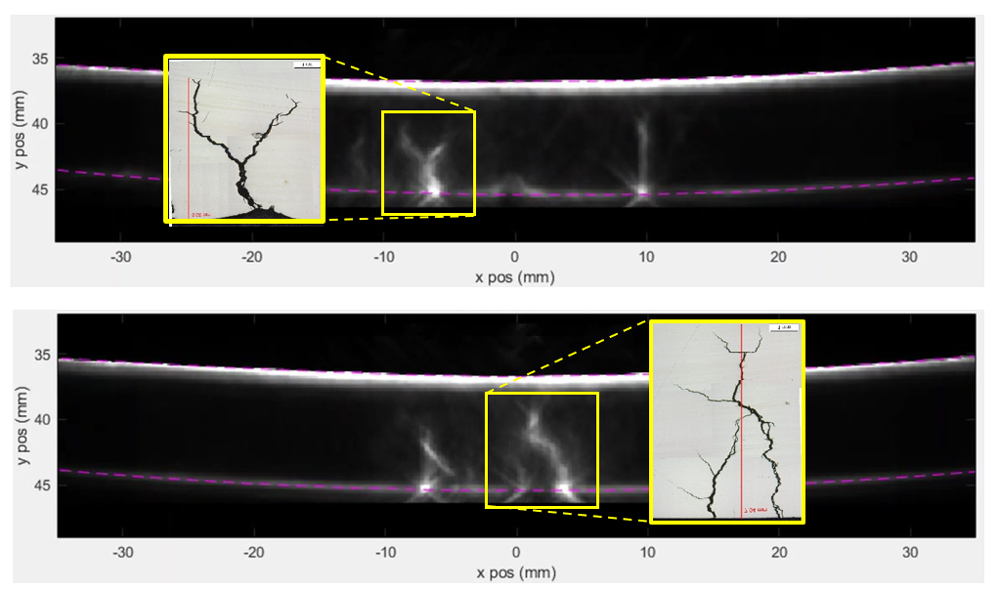
A key advantage of this approach is its ability to characterize defects. Rather than providing limited, amplitude-based indications, the imaging process offers detailed information about defect morphology, orientation and position relative to weld features. Surface-breaking cracks, buried cracks, weld defects and base material anomalies can be clearly distinguished. FIG. 3 depicts complex crack morphology, including branching or inclined crack planes, which can also be visualized.
Testing and Validation Results
The inspection system was evaluated through controlled testing with prototype robotic phased array scanner modules. Tests were conducted in liquid-filled pipelines with nominal diameters representative of offshore applications. Both 10-in. and 18-in. test spools were used, and multiple wall thicknesses were evaluated to reflect typical riser and loading line designs.
Test specimens included pipe bodies and girth weld sections with electro-discharge-machined (EDM) notches, manufactured weld defects and natural-like crack geometries. The EDM notches served as an idealized representation of cracks, enabling the assessment of detection sensitivity and sizing accuracy.
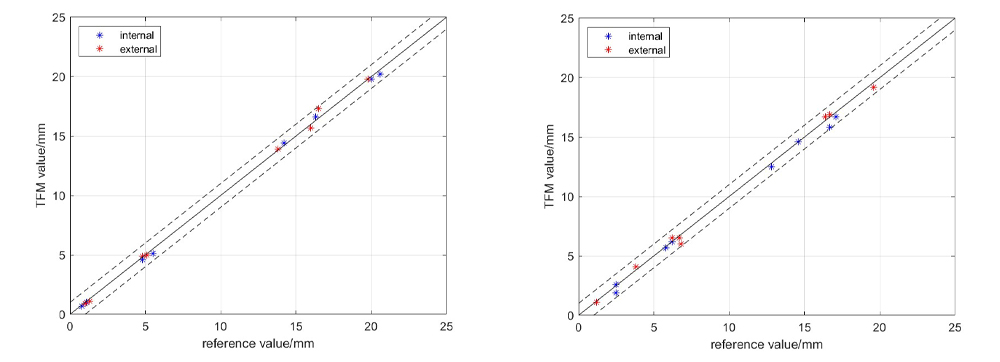
The results demonstrated the reliable detection of both pipe body and girth weld defects. The depth sizing accuracy of the EDM notches showed small absolute errors, with the majority of measurements within sub-millimeter ranges (FIG. 4). Slightly larger variations were observed in the weld areas due to the increased geometric complexity. However, overall performance remained well suited for integrity assessment applications.
Realistic, manufactured weld defects were used to confirm the system’s ability to generate images of crack morphology and precise location, including surrounding weld features such as porosity, lack of fusion and weld toe undercut. Complex defect shapes, including branched and inclined crack fields associated with stress corrosion cracking in base materials, were successfully resolved (FIG. 5).
Implications for Integrity Management of Unpiggable Pipelines
For operators managing unpiggable offshore pipelines, this technology has significant implications. The ability to obtain high-resolution internal inspection data from SCRs and loading lines offers a new level of confidence in integrity assessments.
Rather than relying on conservative assumptions or indirect indicators, integrity engineers can now base engineering critical assessments and remaining life analyses on detailed, defect-specific data. Accurate information on crack depth, orientation and location within the weld, as well as contextual details such as porosity, lack of fusion or weld toe undercut, support more realistic fatigue and fracture mechanics calculations.
From a lifecycle perspective, this enables better-informed decisions regarding inspection intervals, mitigation measures, operational limits or life-extension strategies. In assets where access is limited and intervention costs are high, reducing uncertainty can directly improve safety and optimize expenditure.
Takeaway
Steel catenary risers and offshore loading lines are among the most challenging and fatigue-critical pipeline assets in service today. Their classification as unpiggable has historically limited inspection options and constrained the quality of data available for integrity management.
However, robotic ILI combined with PAUT, FMC and adaptive TFM imaging provides a viable and powerful inspection solution for these assets. This approach enables non-contact, high-resolution ultrasonic imaging of complex weld geometries and delivers detailed defect detection, classification and sizing capabilities that were previously unavailable for many offshore pipelines.
As validation efforts continue and deployment experience grows, this technology is expected to play a key role in closing the inspection gap for unpiggable pipelines and in supporting risk-informed, data-driven integrity management of critical offshore infrastructure.
About the Authors
MARKUS GINTEN earned university degrees in civil engineering and business administration, completing his studies in both Germany and China. He has more than 20 yrs of experience in the pipeline industry, and has worked as an Engineer and Product Manager in the United Kingdom and Germany, and as an Area Sales Manager in the U.S.
In these roles, he was responsible for the development and deployment of innovative inspection and integrity solutions, including electro-magnetic acoustic transducer (EMAT) ILI technologies in North America. During his tenure as Area Sales Manager, he led business development activities across the western region of the U.S. In his current role as Head of Group Business Line at ROSEN Group, Ginten is responsible for the ILI business, encompassing conventional and robotic inspection solutions for liquid and gas pipelines.
RÜDIGER BAUERNSCHMITT is a Senior Engineer at ROSEN, focusing on the development of next-generation solutions in PAUT. He earned a PhD in physics from the University of Karlsruhe and studied in Germany and France. Bauernschmitt has more than 25 yrs of experience in research and development in the field of non-destructive testing (NDT). His expertise spans NDT-related physics, signal processing and sensor electronics, with a particular focus on ultrasound, electromagnetic acoustic transducers (EMAT) and eddy current methods.
NICO GRUHLER studied physics at the Karlsruhe Institute of Technology (KIT) and completed his PhD at the University of Münster. His research focused on integrated nanophotonic circuits for on-chip sensing applications spanning the visible to mid-wave infrared spectrum. Since joining the ROSEN Group in 2019, Gruhler has worked to advance PAUT for inline pipeline inspections, emphasizing imaging methodologies. He has contributed to the development of ROSEN’s robotic PAUT imaging weld scanner service for challenging pipeline inspections.
BENJAMIN KOSTER is a Senior Application Specialist at the ROSEN Technology and Research Center GmbH in Lingen, Germany. He provides technical expertise and drives innovation in the development of challenging applications and products. Koster earned a PhD in geoscience/geophysics from RWTH Aachen University and has more than 11 yrs of experience in the pipeline inspection industry. His areas of expertise include measurement data, technology and software, with a particular emphasis on ultrasound and other methods.
Literature Cited
- Amorim, A. R., American Society of Mechanical Engineers (ASME), “Free-hanging riser fatigue improvement using high strength steel,” Ocean Offshore And Arctic Engineering, June 2025, online: https://doi.org/10.1115/OMAE2025-152423
- Yenduri, A., American Society of Mechanical Engineers (ASME), “Shaped steel catenary riser design optimization using artificial intelligence,” Ocean Offshore And Arctic Engineering, June 2025, online: https://doi.org/10.1115/OMAE2025-152191
- Koster, B., T. S. Kristiansen and M. Ginten, “Enhancing pipeline integrity and efficiency: Tethered UT inspection with a focus on data quality and operational optimization,” Subsea Pipeline Technology (SPT), 2024.
- Nonemaker J. and F. Perez, “Gulf of Mexico riser inspections using a self-propelled ultrasonic solution,” Offshore Technology Conference (OTC), 2026, Houston, Texas (U.S.), 2026.
- Holmes, C., B. W. Drinkwater and P. D. Wilcox, “Post-processing of the full matrix of ultrasonic transmit-receive array data for non-destructive evaluation,” NDT and E International, Vol. 38, Iss. 8, December 2005, online: https://doi.org/10.1016/j.ndteint.2005.04.002