
Using Asset Health Rankings to Improve Pipeline Maintenance Decisions
D. K. MOHAN, SLB, Houston, Texas (U.S.)
Across oil and gas operations, geographically distributed fleets of pumps, compressors, drivers and associated rotating equipment support critical production and energy transport systems. While individual assets are often instrumented and monitored, maintenance and asset management decisions are still frequently made without a clear fleet-wide view of asset condition.
Maintenance planners routinely face questions such as:
- Which assets should be prioritized for inspection or intervention?
- Which assets can safely remain in service?
- Which assets are the best candidates for refurbishment or replacement?
Too often, these decisions rely on disconnected information. Asset availability, recent failures or operating-hour thresholds frequently drive maintenance priorities—not necessarily because they represent the best indicators of equipment health, but because more comprehensive information is difficult to consolidate into a practical decision-making tool.
This article presents a data-driven methodology that combines asset health indicators, operating exposure and maintenance history into a weighted composite ranking, providing maintenance and asset management teams with a consistent framework for prioritizing work across geographically distributed oil and gas assets.
Limitations of Current Practices and CMMS-Centric Views
Most oil and gas organizations rely on computerized maintenance management systems (CMMSs) as the primary repository for maintenance records. While these systems effectively track work orders, maintenance costs and schedules, they are not designed to evaluate fleet-wide asset health.
A typical CMMS:
- Does not incorporate operational health indicators derived from equipment performance.
- Provides little comparative visibility across similar assets.
- Focuses on historical maintenance activities rather than identifying emerging degradation.
As a result, maintenance planners often lack visibility into which machines are deteriorating faster under similar operating conditions or which assets could become future reliability constraints.
Likewise, equipment allocation decisions are frequently based on availability alone. Assets remain in operation as long as they continue running, often without considering:
- Relative equipment degradation.
- Uneven utilization across the fleet.
- The cumulative effects of repeated minor repairs.
This approach can produce significant imbalances, with some machines accumulating excessive wear while comparable assets remain underutilized.
Operating Hours Tell Only Part of the Story
Operating hours remain one of the most common criteria for refurbishment planning. While they measure equipment exposure, they reveal little about operating quality or maintenance effectiveness.
Two pumps with identical operating hours may present dramatically different risk profiles if one operates under heavier loading conditions or exhibits declining efficiency.
Relying solely on operating hours can therefore lead to:
- Premature refurbishment of equipment that remains healthy.
- Delayed intervention on machinery experiencing accelerated degradation.
A broader assessment is required—one that evaluates how equipment has performed throughout its service life rather than simply measuring elapsed operating time.
Deriving Health Indicators from Operational Performance
The proposed methodology begins by developing regression-based performance models that characterize expected equipment behavior under comparable operating conditions.
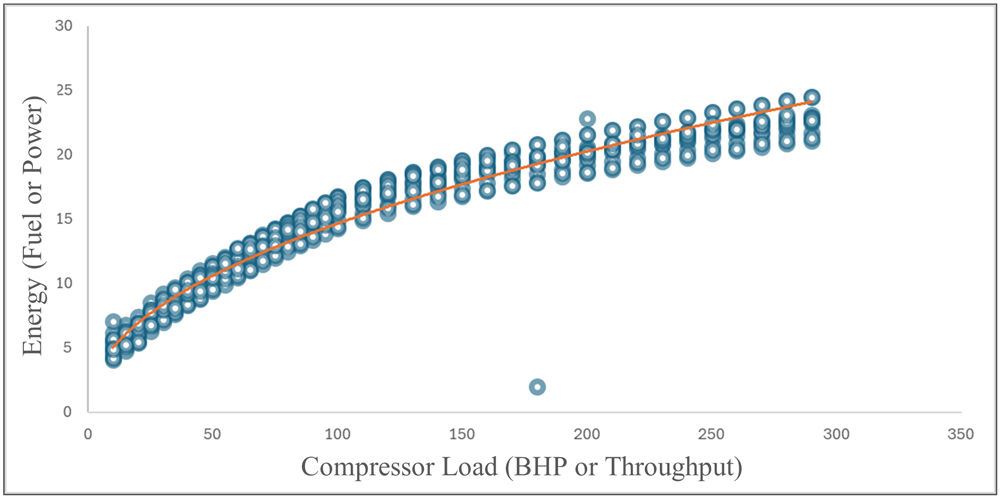
Operational variables such as compressor load or throughput are used to predict expected performance metrics, including fuel consumption and efficiency. Differences between predicted and actual performance are quantified using statistical measures such as root mean square error (RMSE).
Rather than evaluating isolated operating points, health indicators are calculated using rolling data windows spanning approximately 3 mos–6 mos. This approach minimizes the influence of temporary operating disturbances while emphasizing sustained equipment behavior.
Evaluating performance over these rolling periods enables maintenance teams to identify:
- Gradual efficiency losses.
- Recurring abnormal operating behavior.
- Long-term effects of operating conditions.
FIG. 1 illustrates a regression relationship between compressor load and fuel consumption. By training a prognostics and health management (PHM) model using historical operating data, RMSE becomes a measurable health indicator. Increasing deviations between predicted and observed performance provide an early quantitative indication of abnormal behavior or equipment degradation.
From Health Indicators to a Decision-Oriented Composite KPI
Although health indicators provide valuable insight, they are not sufficient on their own for fleet-level decision-making.
Maintenance teams must simultaneously consider equipment condition, operating exposure and maintenance cost.
The proposed methodology combines these elements into a weighted composite key performance indicator (KPI) consisting of:
- Health deviation derived from regression-based models.
- Operating exposure measured through operating hours.
- Maintenance burden represented by work-order expenditures.
Normalization Across the Fleet
To enable meaningful comparisons, each KPI component is normalized across peer groups of similar assets.
Percentile-based normalization—typically between the 10th and 90th percentiles—reduces sensitivity to statistical outliers while ensuring that rankings reflect relative fleet risk rather than absolute operating values.
Weighted Composite KPI
The composite KPI is calculated using:
Composite KPI = 0.6 × Health Score + 0.2 × Operating Exposure + 0.2 × Maintenance Spend
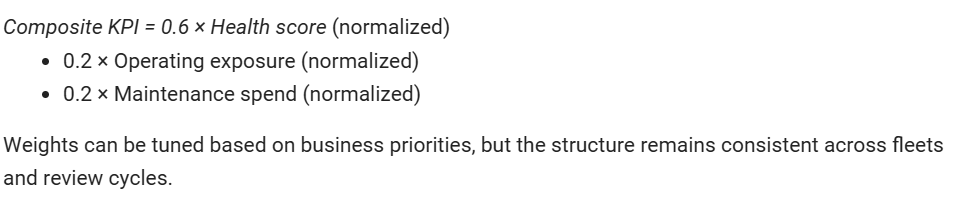
Although weighting factors may be adjusted to reflect organizational priorities, the overall framework remains consistent across different asset fleets and maintenance review cycles.
Why Weighting Matters
A weighted methodology overcomes many shortcomings associated with single-metric maintenance decisions by simultaneously considering:
- Emerging equipment degradation.
- Cumulative operating exposure.
- Economic maintenance impacts.
Together, these factors provide a practical indicator of operational risk that is particularly valuable when maintenance resources, inspections or planned outages must be prioritized across multiple facilities.
Fleet Ranking and Maintenance Triage
After composite KPIs are calculated, assets are ranked across the fleet.
This ranking converts large volumes of operational data into a practical maintenance prioritization tool.
Assets generally fall into three categories:
Immediate Review — High Composite KPI
Assets with the highest composite KPIs may pose the greatest threat to station reliability or increase the likelihood of throughput disruptions if corrective action is delayed.
Monitor — Moderate or Increasing KPI
These assets warrant continued observation and may be scheduled into upcoming maintenance windows before conditions worsen.
Healthy — Low and Stable KPI
Assets exhibiting consistently low KPIs can remain in service with confidence, allowing maintenance resources and spare equipment to be allocated elsewhere.
This prioritization enables maintenance teams to focus on the right assets at the appropriate time rather than reacting solely to isolated equipment alarms (FIG. 2). The normalized health deviation, operating exposure and maintenance expenditure are combined into a weighted composite KPI to support maintenance prioritization.
Composite KPI = 0.6 × Health + 0.2 × Operating Exposure + 0.2 × Maintenance Spend

Illustrative Example
Consider a fleet of pipeline pump units operating across several stations.
Historically, equipment rotation depended primarily on availability, while refurbishment decisions were based largely on operating hours.
Applying the composite ranking methodology, health indicators are calculated using the previous 6 mos of operational data and combined with operating hours and maintenance expenditures.
During one review cycle, several pumps accumulate elevated composite KPI values because of sustained performance deviations and increasing maintenance costs.
Although these assets have not yet experienced major failures, they are prioritized for inspection. Follow-up evaluations identify early efficiency losses and component wear, allowing repairs to be scheduled during planned maintenance outages.
Meanwhile, equipment with high operating hours but consistently low composite KPIs remains in service, avoiding unnecessary refurbishment of assets that continue to perform well because of effective maintenance practices.
Over time, the ranking methodology provides maintenance planners with a repeatable, data-driven framework for refurbishment planning, equipment loading and long-term asset life-extension decisions.
Integration with Maintenance Workflows
Fleet health ranking complements existing CMMS platforms rather than replacing them.
The CMMS continues serving as the official maintenance record, while the composite KPI provides operational context unavailable through maintenance history alone.
Typical integration points include:
- Outage and turnaround planning.
- Maintenance prioritization.
- Asset loading and duty balancing.
- Spare equipment planning and intervention sequencing for critical assets.
Implementation Considerations
The methodology is deployment-agnostic.
Organizations may process data through cloud-based platforms, on-premises systems or periodic offline workflows depending on operational requirements.
Implementation can begin with a limited group of assets before expanding across larger fleets. Health indicators and weighting factors can also be refined over time without disrupting existing maintenance programs.
Takeaway
Managing large fleets of rotating equipment requires more than monitoring availability and operating hours.
By combining operational health indicators, equipment exposure and maintenance history into a weighted composite ranking, organizations gain a more complete understanding of fleet condition.
The methodology helps maintenance and asset management teams identify which assets warrant intervention before reliability or throughput is affected, while supporting more effective inspection planning, refurbishment decisions and long-term asset management across geographically dispersed operations.
About the Author
DINESH KRISHNA MOHAN is an Asset Performance Management and Digital Leader with nearly 20 yrs of industry experience, including 15 yrs in the oil and gas services sector. His work focuses on applying prognostics and health management (PHM) and condition-based maintenance to improve equipment reliability and operational performance.
With experience spanning engineering, equipment testing and refurbishment, Mohan combines asset lifecycle expertise with data-driven analytics. He has led the development and deployment of scalable digital solutions that transform operational data into actionable insights, helping operators reduce downtime and extend equipment life across global operations.
In his current role, Mohan develops practical, engineer-focused analytics frameworks that support more reliable and predictive decision-making for complex field operations. He earned a BS degree in mechanical engineering from Anna University and an MS degree from Nanyang Technological University, Singapore.