
GD Bandlock 2 Delivers Rapid Access for High-Pressure Pipeline Systems
(P&GJ) — As the industry navigates a complex set of priorities—from managing aging infrastructure and data-driven maintenance to the push for unmanned, remote operations—traditional pigging processes are increasingly being modernized to meet new efficiency and sustainability standards.
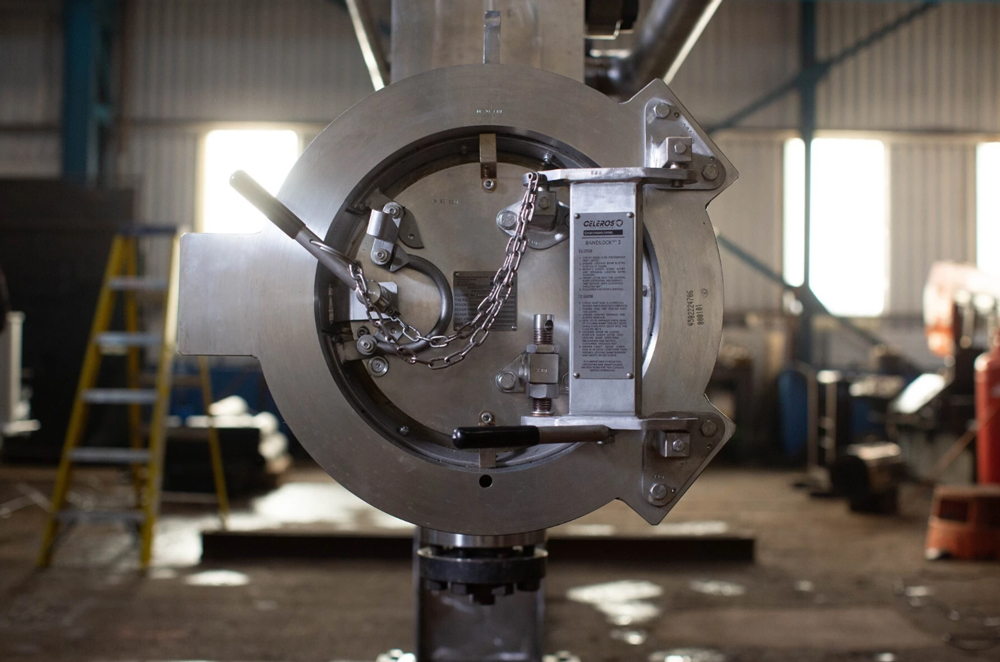
GD Engineering is a leading brand under Celeros Flow Technology, and a global leader in the manufacture of quick opening closures. Their GD Bandlock™ 2 is the original and benchmark design for global high-pressure applications with more than 20,000 units in operation worldwide (FIG. 1).
GD Bandlock 2 closures provide horizontal or vertical access to any pressure vessel in seconds. Compared with other quick-opening closures they can be operated safely at a remarkable speed in any unit size and can be opened or closed in less than a minute, with no special tools required.
Computer-aided technology has played a large part in the design of Bandlock 2. The main pressure loaded sections have been designed to save weight by employing finite element analytical (FEA) techniques and proof testing by strain gauges, while still adhering to primary pressure vessel code requirements. Typical quick opening closure applications include pipeline pig traps, filters, coalescers, strainers, separators, meter skid systems and hydrocyclones.
The tried and tested locking band mechanism that gives the range its name is a duplex stainless-steel conical thrust ring fitted between the door and hub, transmitting the pressure load uniformly around the full 360° circumference of the hub.
Integral safety devices. Safety has been engineered into the Bandlock 2 at every stage of its design and manufacture. A hand-operated pressure warning screw integrated into the mechanism prevents the door being unlocked until it is confirmed that the vessel’s internal pressure has been relieved. Additional secondary safety features, such as mechanical key interlocks, can be fitted and integrated with control valve operations.
For complete safety, the locking band is visible at all times, which satisfies design code requirements and enables the operator to actually see that the door is securely closed and locked.
Door hinging. For horizontal use, the door is double pivoted on hinges with self-lubricating bearings. The bolted fitment allows adjustment for wear and can be specified for right or left swing. Vertical installation includes a davit that enables the Bandlock 2 door to be lifted and swung clear of the hub. At diameters of > 30 in., lifting eyebolts are normally fitted instead of the davit, so that the door can be lifted out of the way.
To achieve a completely pressure-tight seal, the purpose-designed servo acting lip seal energizes at zero pressure. For both horizontal and vertical installations, the seal is housed in the door away from the working area for protection and long life and is easily fitted without tools. The one-piece molding is available in a range of elastomers and incorporates a stainless-steel spring to prevent extrusion and provide a full vacuum capability.
Forged-steel hubs with forged or plate doors can be supplied to meet all international material specifications. The National Association of Corrosion Engineers (NACE) Standard MR-01-75/International Organization for Standardization (ISO) 15156 materials are available.
The Celeros GD Engineering brand manufacturers the Bandlock 2 closure with integral flanged connections. These can be fitted into new or existing installations and can replace a blind flange. They are ideal for installations where the operational overhead for opening an existing blind flange is uneconomical over the life of the installation.
Blind flanges are often fitted because they provide lower cost on capital investment at the initial construction phase. It may not be until later in the life of an installation that the reality of the continuing overhead associated with opening such a flange is realized. The flange Bandlock 2 closure offers a quick and easy solution to this problem and, over the lifetime of the pressure vessel, may provide significant cost and time savings to the operator.