
Linear MMO Anodes Improve Cathodic Protection for Congested Plant Piping Systems
A. MAHGOUB, Saudi Aramco, Dhahran, Saudi Arabia
(P&GJ) — Cathodic protection (CP), when applied properly, is an effective means to prevent corrosion of underground plant piping. For many underground applications, such as pipelines, CP system design is relatively straightforward. However, plant and facility environments are not simple applications. Plants have congested underground piping systems in a tightly spaced footprint. The presence of copper grounding systems, foundations with reinforcing steel embedded in concrete, conduit, utility piping and structural pilings (either bare or concrete with reinforcing steel) can greatly complicate the task of designing a pipe CP system.1
For simple plant facilities, it is possible to isolate the piping and utilize a conventional galvanic corrosion prevention system. This works only if the plant piping is electrically isolated from other underground structures. For most plant and facility applications, it is impractical to isolate the piping from the grounding system for the life of the facility. In these cases, an impressed current anode system is the only alternative. This article represents a linear mixed metal oxide (MMO) anode system, which is an optimum method to provide adequate CP to the piping network in crowded areas of oil and gas plants.
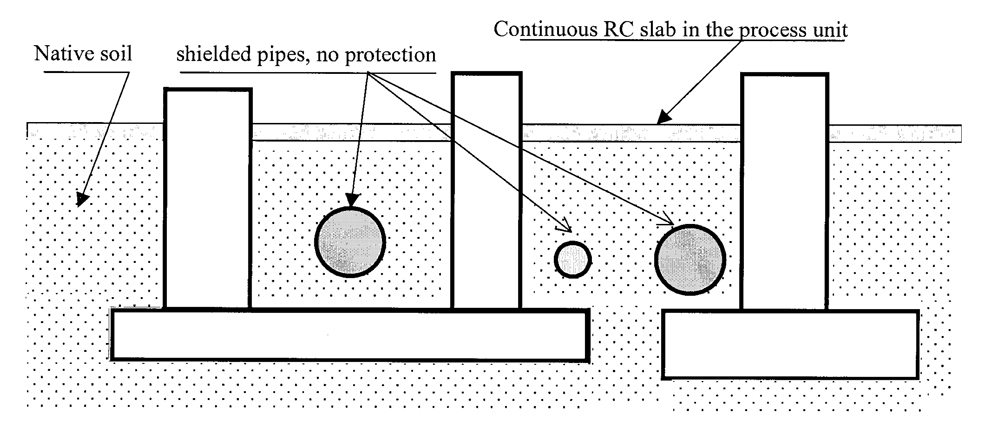
There are two conventional approaches to cathodically protect underground plant piping using impressed current anodes: a deep anode bed and a shallow/distributed anode bed. However, there are three principal industry challenges that are crucial for any CP system in plant piping and in utilizing the conventional impressed current cathodic protection (ICCP) system.2,3 The first challenge is the previously mentioned distribution issue due to the highly congested underground environment common to most plants. The second critical factor is isolation in the presence of a pervasive copper grounding network. The third obstacle is the probability of direct current (DC) interference due to stray current (FIG. 1).
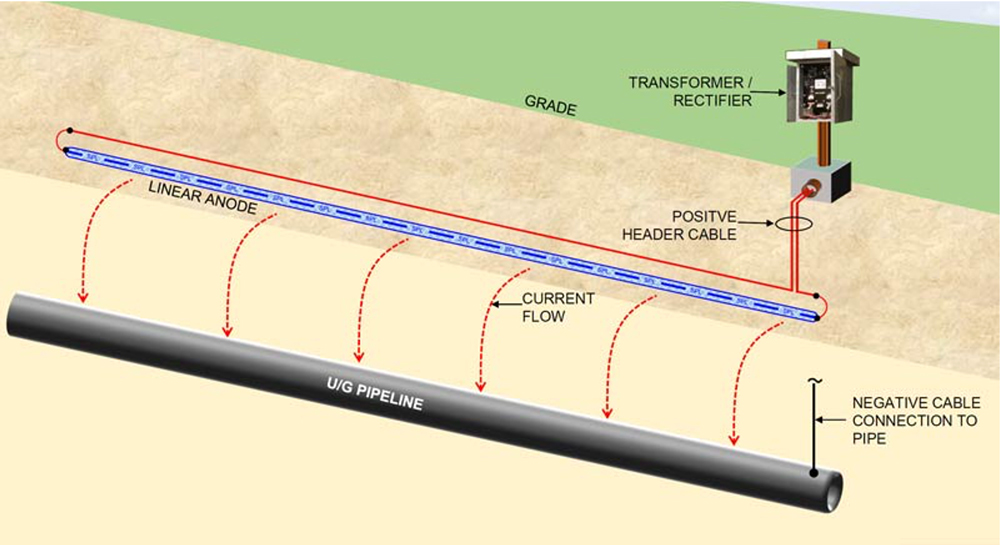
The linear mixed metal oxide (MMO) anode is a long-line, flexible, cable-like anode that is placed in close proximity to the piping network. Uniform distribution of CP current is therefore achieved on applications where many conventional anodes ground beds do not work.4,5 In contrast to conventional anode ground beds CP systems, a linear MMO anode is placed in the ground parallel and in close proximity to the plant piping to be protected and provides uniform distribution of protective current to the entire steel surface, thereby maintaining the steel-to-soil "instant-off" potential in the required protection criteria (FIG. 2).6
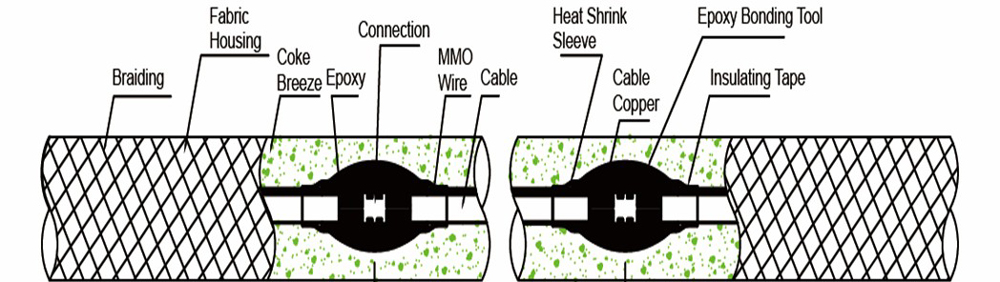
Backfilled linear anode. The MMO-based anode represents the second generation of backfilled linear anodes. Replacing platinum-based catalytic anodes with MMO-based wire anodes is more cost-effective, less prone to failure, extends the anode system’s life, contains a larger range of current outputs and provides a far more robust material (FIG. 3). The key elements that contribute to the MMO linear anode composition include:
- Core: The core is crafted from high-quality titanium wire and meticulously coated with a catalyst blend derived from MMOs, predominantly featuring iridium and tantalum oxides.
- MMO coating: MMO coating incorporates an electrocatalytic conductive element, which acts as a catalyst to drive the essential reactions for current generation. It embeds bulk oxides that serve as a protective shield, ensuring the substrate material remains resistant to corrosion.
- Acid resistance fabric: This fabric is designed to provide an additional layer of protection against acidic environments. Its unique composition ensures that the MMO linear anode remains safeguarded from potential corrosive effects of acids, thus enhancing its longevity.
- Protective braid: Surrounding the anode is a protective braid that offers mechanical protection. This robust braid ensures that the anode is shielded from external wear and tear, making it more durable and resilient to external forces.
- Coke breeze: Coke breeze is a backfill material. It enhances the conductivity of the anode and aids in distributing the current uniformly. This ensures efficient operation and reduces potential hot spots.
The MMO linear anode functions as a distributed system that includes an infinite number of continuously spaced anodes. This system offers the optimal technical CP solution while minimizing the required current output as detailed here:
- The system skips electrical isolation because the MMO linear anode is located next to the piping being protected. The anode is closely coupled to the piping and operates with a very low anode gradient that minimizes any losses to nearby structures, including grounding.
- The system maintains uniform current distribution by positioning the anode parallel and in very close proximity to the piping being protected. The linear anode CP system design eliminates the need for supplemental anodes to address areas where remote anodes may be shielded after the CP system is commissioned. Wherever the piping goes, the linear anode follows in the same trench. This also makes it very simple to adapt the design during piping revisions that may change the piping system routing as the plant construction proceeds.7,8
- The system eliminates stray current risks, close proximity to the piping being protected significantly limits current losses to other structures and virtually eliminates shielding and stray current concerns. This also significantly reduces the total current requirements for the system, reducing the rectifier requirements.
- The MMO linear anode is installed in very close proximity to the piping that needs to be protected. This minimizes the risk of third-party damage and reduces trenching required for buried cable and drilling required for distributed anodes. If installed in conjunction with the piping, the anode can be placed in the same trench as the piping, affording the anode protection from external damage by the piping itself. This is a very cost-effective CP installation when installed concurrently with the piping.
- When installed concurrently with the piping, the installation is simply a matter of laying the anode cable in the trench—no further drilling is needed.
CASE STUDY
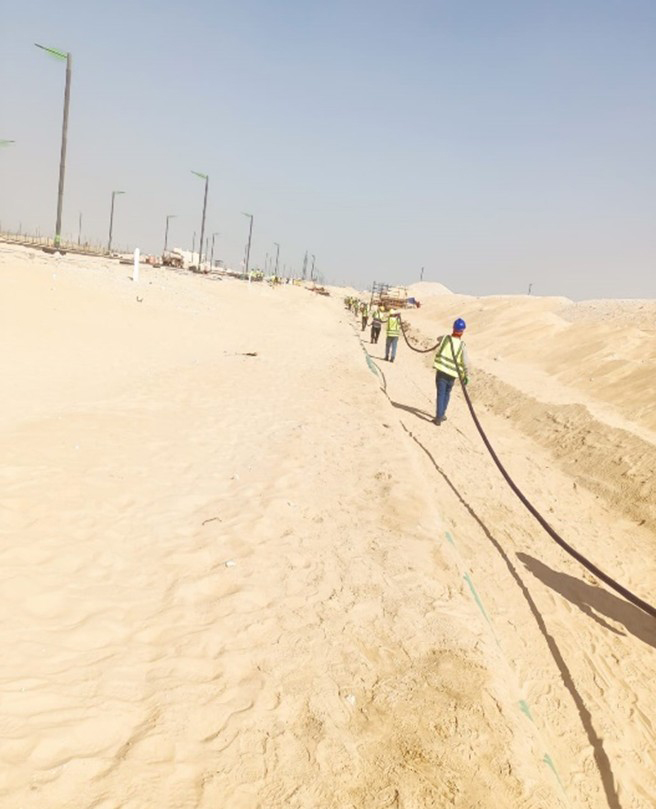
This section outlines the proposed CP system by linear MMO anodes for new 8-in. and 6-in. underground header and branch underground piping’s network. The total length of the gas grid distribution piping network is 4,900 meters (m). The pipes will be protected by a permanent ICCP system for 25 yrs, according to CP specifications, by using new CP systems of 25V/15A rating. The MMO linear anodes consist of a long MMO/titanium (Ti) wire welded to multiple spots with copper cable packaged in fabric jacket and fulfilled with calcinated coke. The wire will be installed parallel to the pipelines in the same trenches by maintaining a minimum distance of 0.5 m–0.8 m (FIGS. 4 and 5).
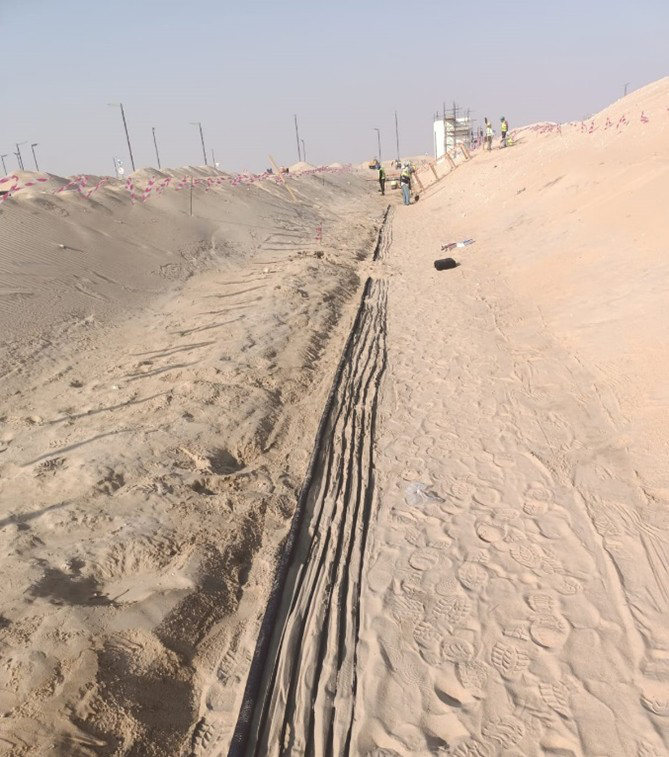
The MMO anode wire is connected to the header cable at the factory via a high-pressure crimp connector to ensure a low-resistance connection. That connection is then sealed in a splice kit with epoxy resin to prevent water intrusion.9 The header cable to anode feeder cable connections are performed onsite as per manufacturer specifications and standard procedures.
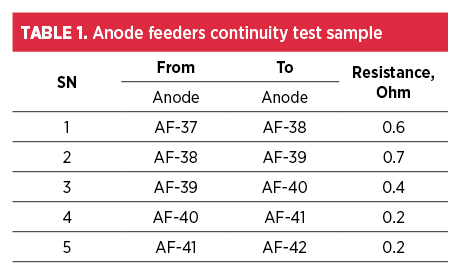
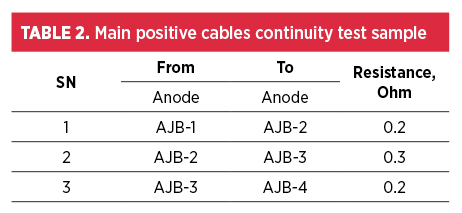
The CP system must be examined to confirm the proper installation of all components. It is crucial to verify the connections and continuity of the positive anode cables. Resistance measurement between various anode feeders and between different main positive cables is required to ensure electrical continuity. The resistance reading should be less than 1 ohm. Sample results of the continuity test are detailed in TABLES 1 and 2.
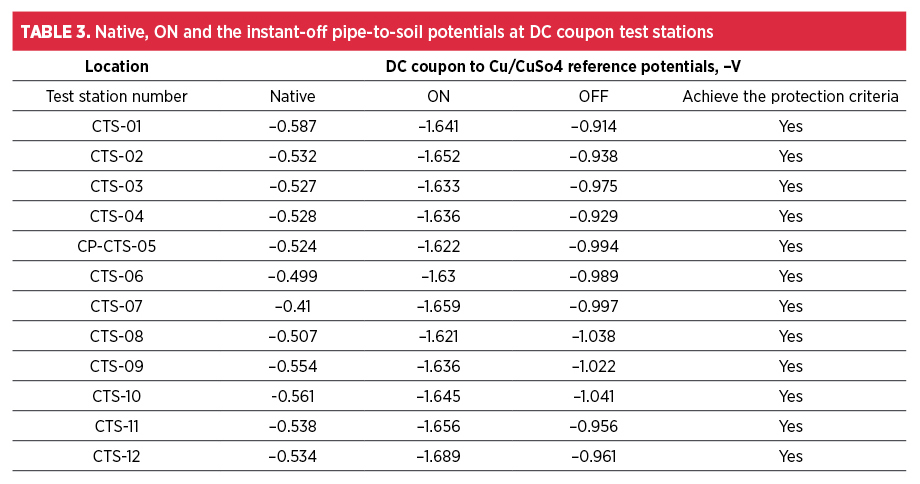
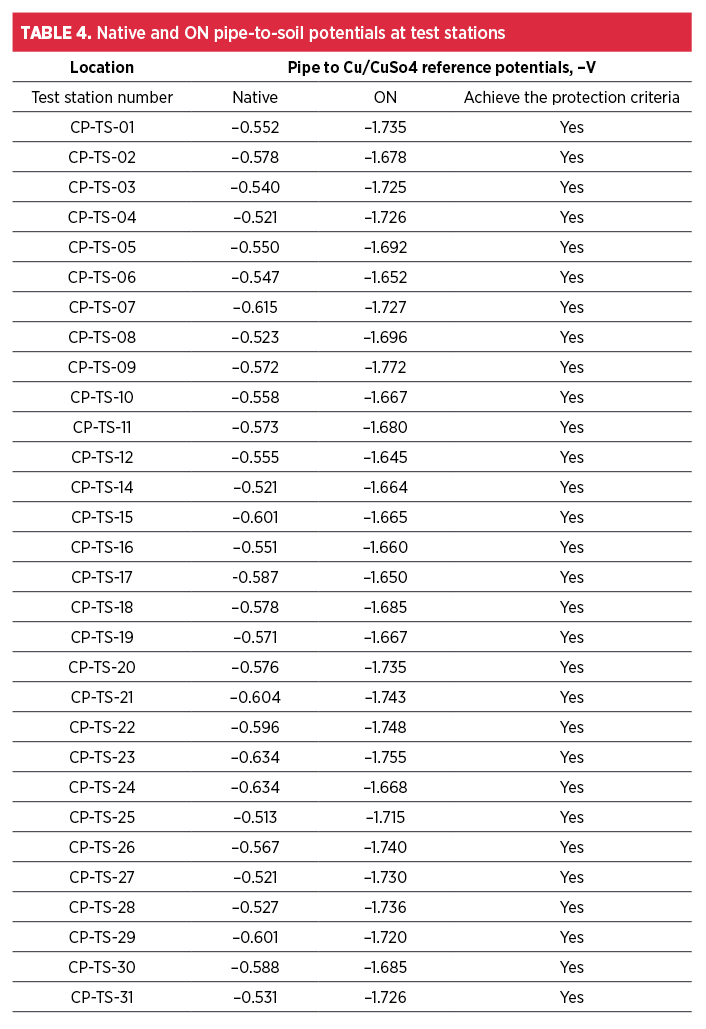
The CP commissioning activities were completed. During the commissioning, temporary sacrificial anodes were disconnected and the piping given 96 hrs to depolarize before the native potentials were measured. These lay in the range of –410 mV to –635 mV copper/copper sulfate (CSE) with an average of –550 mV. The permanent CP was commissioned and energized and the piping allowed to polarize for 48 hrs at 4.5 V/2.2 Amp setting. ON pipe to soil potentials were measured at all test stations and the instant-off pipe to soil potentials were then measured at DC coupon test stations. Both ON and instant-off potentials met the required CP criteria as specified in company specifications. The records of native, ON and the instant-off pipe to soil potentials are shown in TABLES 3 and 4.
Discussion. Shielding of underground piping network in congested oil and gas plants is one of the major problems when CP is applied for its protection from external corrosion. Process equipment reinforced concrete foundations and electrical plant groundings are an integral part of the plant. Not only is a significant amount of protective current consumed by these elements, but they also restrict the flow of the protective current to the intended structures from the distributed or remote ground bed.
MMO linear anodes can be installed alongside new pipelines, as current distribution and polarization are improved when anodes are placed close to the pipeline. In plant piping systems, where current leakage and stray currents caused by reinforced concrete foundations and grounding rods are common issues, the use of continuous, closely installed MMO linear anodes is an effective method for achieving efficient CP and preventing soil-side corrosion.10
The utilization of MMO linear anodes for plant piping protection will lead to a substantial decrease in project installation and maintenance expenses, as well as improved performance compared to the initial CP distributed anode method. In this study, the adoption of linear MMO anodes replaced the original plan to drill and install 50 distributed anodes. As a result, approximately 3,850 m of cable trenching and 50 drilled anodes with a total depth of 250 m were eliminated. Additionally, the need for anode bed replacement over an extended period (25 yrs–40 yrs) was avoided, leading to significant capital cost savings.
About the author
Dr. AHMED MAHGOUB is a CP subject matter expert for Saudi Aramco in Dhahran, Saudi Arabia. He has more than 19 yrs of experience in the consulting, engineering, constructing and commissioning of different CP structures. Mahgoub is a NACE/AMPP CP specialist, Icorr CP specialist, fellow of Icorr and NACE/AMPP senior corrosion technologist.
LITERATURE CITED
1 International Organization of Standardization, “ISO 15589-1: Petroleum, petrochemical and natural gas industries—cathodic protection of pipeline systems, Part 1: On-land pipelines,” 2015, online: https://www.iso.org/standard/54503.html
2 Association for Materials Protection and Performance (AMPP) (formerly NACE International), “SP0169: Control of external corrosion on underground or submerged metallic piping systems,” 2013.
3 AMPP, “SP0286: Electrical isolation of cathodically protected pipelines,” 2002.
4 British Standards Institution, “EN 14505: Cathodic protection of complex structures,” 2005.
5 AMPP, “Cathodic protection design considerations in congested area facilities,” 2018.
6 AMPP, “Effectiveness of cathodic protection system for buried flow lines near gathering centers by using continuous linear anodes,” 2012.
7 AMPP, “Simulation of linear anode-pipe cathodic protection system: Primary and secondary current and potential distribution analysis,” Corrosion, Vol. 75, No. 9, pp. 1128–1135, 2019.
8 AMPP, “Cathodic protection of piping network in congested area of a petrochemical plant,” 2005.
9 Middle East Corrosion Conference & Exhibition, “Linear anode for pipeline rehabilitation—thirty years later,” paper MECC2023-19993, 2023.
10 AMPP, “Problems associated with remote anode beds in a very low resistivity soil for the protection of piping network in the congested areas of a petrochemicals complex,” 2003.