
Aging Gas Assets Increase Integrity Risks for Gas Processors
V. LAGAD, Vysus Group, Houston, Texas (U.S.)
(P&GJ) — Gas processing facilities across the U.S.—and increasingly around the world—are entering a critical phase of their lifecycles. Much of the infrastructure that drives today’s midstream and processing sectors was built in the 1980s or earlier, an era defined by different process expectations, diverse materials and varied operating philosophies. Today, these same assets remain the beating heart of North America’s natural gas supply chain, yet they do so after 40 yrs of operation—more than 62% of these assets were built before 1980.
For an industry predicted to play a central role in the energy transition—through liquified natural gas (LNG) growth, blue hydrogen (H₂) and advanced petrochemicals—the integrity of aging assets is not just an engineering concern. Asset integrity is a strategic imperative affecting safety, reliability, operational continuity, turnaround time and shareholder confidence.
This article examines the gas processing sector’s aging asset challenge and the key steps operators can take to manage risk while staying competitive.
Time and chemistry at work. On paper, gas plants appear deceptively stable. The towers stand tall, compressors hum, heaters glow orange and flares burn in the distance. However, beneath the insulation and behind the steel, deterioration is creeping in.
Crisis under insulation. The aging insulation systems that blanket much of the piping and pressure equipment—often older than 20 yrs—are no longer keeping moisture at bay. As a result, corrosion under insulation (CUI) remains one of the most insidious and costly integrity threats. Water ingress accelerates, coatings degrade and corrosion progresses out of sight until it becomes an unmanageable “crisis under insulation.”
For gas processors handling cold, wet gas streams—where dewpoint control, refrigeration and cryogenic service are integral—CUI risk increases exponentially with age. Add chloride-induced stress corrosion cracking (Cl-SCC) in stainless systems and the picture becomes even more complex.
Technologies such as infrared (IR) scanning, neutron backscatter and guided-wave ultrasound are helping operators find hidden corrosion pockets. However, even these tools struggle in congested pipe racks, compact modules or heavily insulated cryogenic units.
Beyond CUI, gas plants grapple with the following common damage mechanisms that become more aggressive with age.
Mechanical fatigue. From pressure swing adsorbers (PSAs) to compressor recycle loops, fatigue driven by pressure and flow cycling is a significant risk, especially in stainless systems that lack endurance limits. With enough cycles, failure becomes a matter of “when,” not “if.” Operators often over-rely on non-destructive examination (NDE) techniques, though NDE cannot guarantee early detection of fatigue cracking. American Petroleum Institute (API)-579 assessments remain essential for predicting crack tolerance, propagation rates and, eventually, remaining life.
Acid gas corrosion. Acid gases [hydrogen sulfide (H₂S) and carbon dioxide (CO₂)] present in the produced process gas cause significant corrosion concerns. Corrosion is typically uniform but can present itself as pitting and highly localized under the right conditions. Corrosion inhibitors or metallurgical upgrades, such as cladding or liners, are used to avoid corrosion in susceptible locations.
These stainless-steel liners can degrade over time and expose carbon steel to significant corrosion rates. The effectiveness of inhibitors based on their continuous availability also plays a major factor over time.
Wells souring over time (increasing H₂S concentration) can introduce wet H₂S cracking damage mechanisms that render existing vessels deficient to operate. This can lead to a significant risk for sulfide stress cracking (SSC) or H₂-induced corrosion (HIC) concerns.
Amine corrosion. Amines are typically used as a solvent to remove acid gases (H₂S and CO₂) from the process gas. Typical types of amines used in the gas processing space include diglycolamine (DGA), diisopropylamine (DIPA) and methyl diethanolamine (MDEA). Other proprietary amine formulations are also used. Lean amine solutions have low conductivity and high pH, so they are generally not corrosive. Corrosion in rich amine systems is localized around high velocity areas and caused by the acid gases that dissolve in the amine, heat stable amine salts (HSASs) and amine degradation products.
Amine/alkaline stress corrosion cracking can also be a significant concern in non post-weld heat treated (PWHT) carbon steel operating at higher temperatures. With aging plants and degradation of steam tracing, piping sections that are typically not PWHT can be exposed to higher temperatures and result in cracking.
API 945 is the governing standard for managing amine corrosion and cracking. As amines degrade over time and with high heat in the reboiler sections, amine degradation products start accumulating and cause significant corrosion in amine reboiler return lines.
Integrity challenge. The message is clear: aging assets do not simply degrade in a predictable linear trend. Degradation rates change, new damage mechanisms get activated, and often in ways that evade traditional time-based inspection programs.
FIG. 1 displays the aging asset problem in a Venn diagram and captures the unfortunate truth for operators dealing with equipment nearing end-of-life and aggressive demands—failure rarely stems from just one issue.
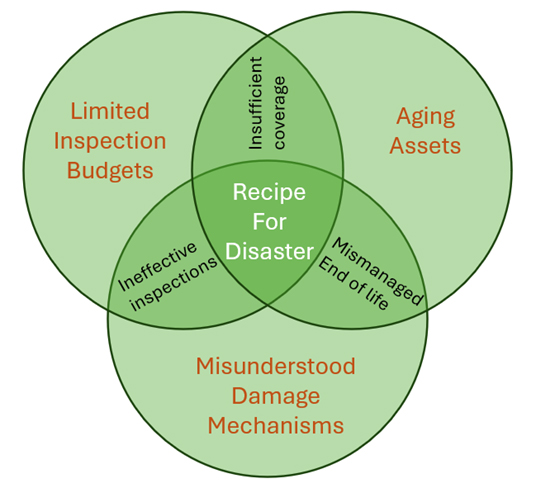
Instead, the highest-risk events arise where limited inspection budgets, misunderstood damage mechanisms, insufficient inspection coverage and mismanaged end-of-life decisions overlap.
In the gas processing world—where aging pressure vessels are exposed to sour gas, thermal gradients, cryogenic processes and cyclic operations—this overlap can become catastrophic without proactive management.
A blueprint for risk reduction: 5 key steps. All aging assets do not necessarily lead to catastrophe. A structured, multi-tiered integrity program can dramatically reduce operational risk.
1. Build a clear policy and strategy. Organizations must recognize aging assets not as routine maintenance concerns, but as enterprise-level risks. That requires:
- Clear policy framework
- Defined metrics for obsolescence
- Integration with existing procedures
- Strong subject matter expert (SME) involvement
- Accountability and governance structures.
These form the “key enablers for success” in any aging asset program.
2. Match strategy with strong execution. Execution without strategy is aimless, and strategy without execution is pointless. This means defining:
- Roles and responsibilities to have clear goals assigned to personnel
- SME empowerment to enable people to make the right decisions
- Communication pathways to escalate and prioritize actions
- Reporting structures to drive accountability and measure performance.
- When execution fails, even the best strategy collapses.
3. Digitize, screen, prioritize. Not all assets deteriorate equally, and equipment age alone is not the sole determining factor. Gas processors need risk-based screening and damage mechanism reviews to identify:
- Degradation mechanisms that affect the equipment
- Failure modes expected and learned from similar facilities
- The true remaining life and maximize it
- Prioritized inspection plans that aim to remove uncertainty by using the right inspection techniques at the right location.
Digitization via an intelligent document management system (IDMS), asset management software and integrated inspection datasets provide visibility to the problem and map the solution path clearly. The goal is to establish a complete and correct representation of reality.
4. Mitigation with precision. High-risk assets demand detailed engineering reviews, evaluate equipment re-rates and use finite element analysis for fitness-for-service assessments to make key repair/replace/run decisions.
5. Review, audit and adjust. What is measured gets managed—regular internal audits, budgeting reviews, root cause analysis (RCA) for failures/turnaround surprises and benchmarking against industry peers are essential to keep mechanical integrity programs on track and credible.
Aging is inevitable: Failures are avoidable. Aging gas processing assets present heightened risks like equipment failures, environmental incidents, safety exposures and production losses. However, with a structured program, strong organizational buy-in and committed engineering and inspection teams, these risks can be managed and even minimized.
Subject matter expertise is key to leveraging available digital tools and inspection technologies, which can be rendered ineffective without experience. Integrity professionals responsible for managing the integrity of these assets must:
- Understand the key aging mechanisms affecting them
- Use engineering tools for accurate remaining-life evaluation
- Embrace new inspection technologies to effectively reduce uncertainty
- Share knowledge across teams and learn from industry experience
- Push for digitization and data quality to accurately represent reality.
The work of an asset/mechanical integrity engineer is not glamorous. It is slow, methodical and data-driven. For an industry increasingly central to the energy transition, a robust aging-asset strategy developed around expertise may be one of the most important investments gas processors make over the next decade.
ABOUT THE AUTHOR
VISHAL LAGAD is the VP of Americas for Vysus Group, a consulting and engineering services company that specializes in risk management and mechanical integrity of oil and gas, petrochemical, fertilizer and other industrial assets. Lagad is a chemical engineer and has been passionately working in the field of corrosion, risk-based inspection (RBI) and asset integrity for more than 25 yrs, along with multiple contributions and active participation at the American Petroleum Institute (API) and the National Association of Colleges and Employers (NACE) committees and conferences.