
Pipeline Bending Strain Analysis Supports Proactive Geohazard Management
Dan Fletcher, Fiberbuilt, Calgary, Alberta, Canada
(P&GJ) — Pipeline bending strain has become a cornerstone metric for pipeline operators to assess geohazard threats on pipeline integrity. Operators rely on bending strain measurements to identify anomalous curvature and quantify pipeline movement over time. Monitoring and measuring these bending strain changes are especially critical in areas with soil movement, floods, scour, erosion or landslide features. Over time, these geological forces can increase pipeline bending strain beyond acceptable limits.
Throughout the last few years, the Pipeline and Hazardous Materials Safety Administration (PHMSA) has increased the focus on managing geohazards, which has led to the issuance of several advisory bulletins.¹ These bulletins recommend pipeline operators integrate geohazard risk protocols (e.g., monitoring geological and environmental conditions) into their integrity management programs.²
An increase in both geohazard-related incidents and PHMSA advisory bulletins indicates a growing need for accessible, cost-effective inertial measurement unit (IMU) technology to gather trajectory data for calculating bending strain.³ Assessing changes in bending strain enables operators to quantify pipeline movement and provide actionable insight into geohazard progression. Bending strain analysis plays a critical role in proactive geohazard management within a comprehensive integrity program.
Why does bending strain matter? Bending strain measures the degree of pipeline deformation along the pipeline axis that occurs from bending stress applied by external loading. If not monitored and managed, bending strain can jeopardize pipeline integrity and lead to loss of containment. Unmanaged increases in bending strain can lead to bending deformation and structural failures, such as girth weld cracking, circumferential fractures or axial stress exceeding pipe strength.
A significant incident illustrating the consequences of unmanaged bending strain occurred in March 2022, involving a 22-in. hazardous liquid pipeline near St. Louis, Missouri (U.S.). The pipeline ruptured at a girth weld, releasing an estimated 3,900 bbl of crude oil adjacent to the Cahokia Creek. Damages and response costs exceeded $20 MM. Investigations later determined the rupture was caused by external loads that resulted from a failure to completely mitigate slope instability in the area.⁴
By actively monitoring bending strain and pipeline movement, operators can assess whether intervention is necessary to prevent failure, maintain pipeline integrity and reduce the risk of containment loss.
What causes bending strain in pipelines? Pipelines experience bending strain in response to external forces from ground movement. Earth movement in variable, steep and rugged terrain—as well as in areas with complex or changing subsurface geological conditions—poses a significant threat to pipeline integrity if not properly monitored and managed. Episodic events such as landslides, subsidence, frost heave or seismic activity can alter the load distribution along a pipeline, creating bending stresses that accumulate over time. In addition, changing climate conditions like increased rainfall and higher temperatures can impact soil stability, even in regions that have historically been stable.
Bending strain can be exacerbated by construction activities that disturb the surrounding soil, including recoating, ditching or uneven backfilling. Because many of the factors that impact bending strain develop over time, regular monitoring ensures that pipeline deformation remains within acceptable limits or receives prompt remediation when unacceptable deviations occur.
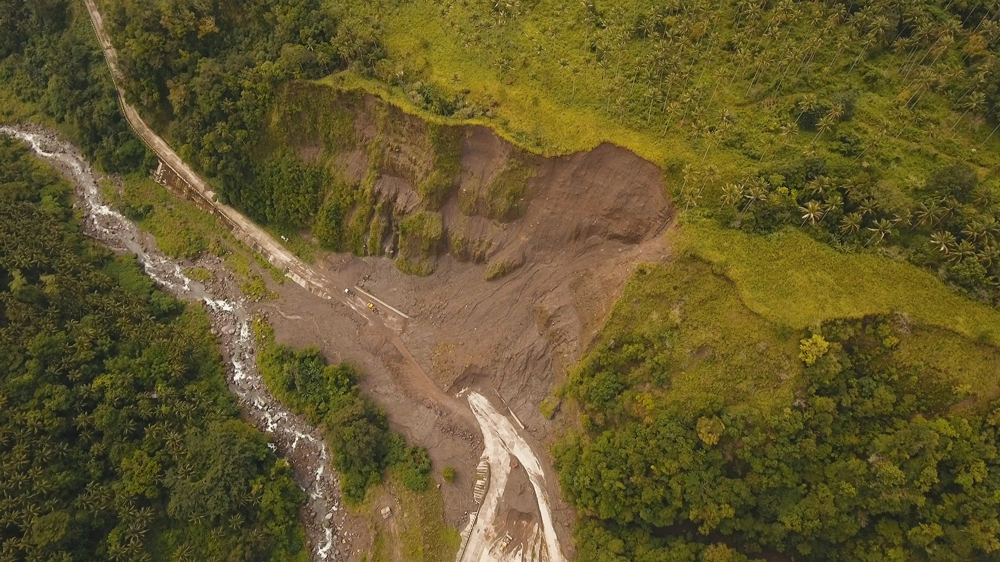
A practical example: movement from landslides. Landslides pose significant long-term threats to pipeline integrity, primarily because the effects can be gradual, making detection and intervention challenging. While a few inches of ground movement per year may have negligible surface indications, this gradual displacement can place a substantial strain on a pipeline’s structure over time, leading to bending, buckling or even rupture.
Consider a landslide moving at 1 in.–4 in. annually: if a pipeline operator uses a monitoring interval of every 5 yrs—as many integrity plans specify—the pipeline could experience up to 20 in. of cumulative displacement before the next inspection period arrives. By then, the damage may require advanced and costly remediation, rather than straightforward preventive measures. This underscores a critical point: every pipeline is susceptible to geohazards, though the degree of vulnerability varies by location and terrain. Frequent and targeted monitoring in high-risk areas is essential to identify early warning signs and mitigate risks before they escalate into catastrophic failures (FIG. 1).
Methods for measuring and monitoring bending strain. Traditionally, inline inspection (ILI) combo tools integrated with IMU capabilities have been the standard for measuring pipeline bending strain. The primary focus of conventional ILI methods is to measure metal loss and detect multiple anomaly types in pipelines, which means the IMU module is one of several technologies that may be a part of the more extensive—and expensive—inspection train.
Due to the operational complexities and high cost of full-scale ILI combo tools, inspections are performed only at the required inspection interval, as per PHSMA's regulations 49 CFR Parts 195 and 192, which state that operators must assess pipeline integrity every 5 yrs for liquid pipelines and every 7 yrs for natural gas pipelines. These extended gaps leave operators relying on historical data, which may not accurately reflect current ground conditions or the potential effects of rapid, geohazard-driven pipeline movement. Performing dedicated IMU bending strain monitoring inspections between ILI combo inspections allows operators to close data gaps and receive early indicators of pipeline movement.
Complementary surface monitoring techniques, such as light detection and ranging (LiDAR), aerial surveys and ground movement sensors, can provide supporting context for historical data on ground movement.⁵ Consistent bending strain monitoring builds a continuous dataset that enables operators to detect trends, evaluate movement rates and prioritize mitigation efforts.
A consistent monitoring strategy enables operators to establish a baseline pipeline profile. Each subsequent run provides updated information that reflects current pipeline conditions. This information can be used to conduct extremely accurate run-over-run analysis or update a probability of failure (POF) assessment. This actionable data enables operators to make proactive integrity management decisions based on current information rather than relying on historical data or statistical models.
The value of understanding bending strain. Understanding and monitoring pipeline bending strain are foundational aspects of a comprehensive geohazard management program. In areas with active earth movement, routine monitoring reduces uncertainty in integrity assessments, supports regulatory compliance and strengthens long-term asset reliability. Access to frequent, actionable insights allows operators to make informed, risk-based decisions about current pipeline conditions and prioritize integrity budgets.
Collaboration and shared knowledge across the industry will improve pipeline safety and reliability moving forward. The author’s company continues to contribute to research initiatives and engage in critical industry dialogue around pipeline bending strain monitoring and movement analysis, helping operators make more informed decisions and protect pipeline assets for long-term performance.
About the Author
DAN FLETCHER is Director of Engineering at Fiberbuilt Pipeline, where he leads the development of IMU-based inspection technology used to measure pipeline movement and bending strain. He holds a bachelor’s degree in aerospace engineering and a doctorate degree in mechanical engineering from the University of Calgary, with a focus on mechanical design and motion analysis.
Fletcher’s background includes early work in engineering system development and hands-on field experience as a Measurement While Drilling (MWD) technician, where he collected directional data and analyzed wellbore positioning in real-time operating environments.
Since joining Fiberbuilt in 2015, he has played a key role in advancing inertial measurement applications for pipeline integrity, combining aerospace-based motion analysis principles with practical field considerations. His work focuses on improving the accuracy, reliability, and usability of IMU data to support geohazard monitoring and integrity decision-making.
LITERATURE CITED
- Pipeline and Hazardous Materials Safety Administration (PHMSA), “Pipeline safety: Potential for damage to pipeline facilities caused by earth movement and other geological hazards (Docket No. PHMSA–2019–0087),” U.S. Department of Transportation, 2019.
- Pipeline and Hazardous Materials Safety Administration (PHMSA), “Pipeline safety: Potential for damage to pipeline facilities caused by earth movement and other geological hazards (Docket No. PHMSA–2022–0063),” U.S. Department of Transportation, 2022.
- Porter, M., G. Ferris, M. Leir, M. Leach and M. Haderspock, “Updated estimates of frequencies of pipeline failures caused by geohazards (IPC2016-64085),” 11th International Pipeline Conference (IPC2016), Calgary, Alberta, Canada, 2016.
- ISSSource, “Causes found in Marathon Pipeline oil leak,” ISSSource, January 30, 2024, online: https://www.isssource.com/causes-found-in-marathon-pipeline-oil-leak/#:~:text=A%20combination%20of%20a%20girth,tributary%20of%20the%20Mississippi%20River
- Guthrie, R. and J. Bracic, “Geohazard program considerations,” Stantec Consulting Services Ltd., September 11, 2024.