
Hydrostatic Testing Mistakes Can Undermine Pipeline Integrity Verification
T. J. MILLER, Kiefner and Associates, Inc., New Orleans, Louisiana (U.S.)
(P&GJ) — Hydrostatic testing remains the industry’s most widely accepted method for demonstrating pipeline integrity. When properly designed and evaluated, hydrostatic testing can provide a high level of confidence in structural capability and leak tightness. However, the reliability of a hydrostatic test depends not only on achieving a specified pressure, but also on the quality of the measurements and the engineering interpretation used to evaluate the results.
A recently performed independent evaluation of a hydrostatic test that had been, albeit incorrectly, declared successful demonstrates many of the concerns that plague many hydrostatic tests today. In that test, the hydrostatic testing contractor’s engineering assessment reportedly included no supporting calculations, and the test was declared successful by two engineers who were friends of the hydrostatic testing contractor. One justification provided was that the test exhibited “really pretty curves” and “really pretty data,” and therefore, additional analysis was unnecessary. The assertion that temperature data were not needed for the evaluation was more troubling. In practice, pressure and temperature correlation is a fundamental characteristic of a properly conducted hydrostatic test and is essential for performing volumetric fluid loss calculations that support leak tightness.
While this example is noteworthy, the underlying issue is not unique. Field experience indicates that hydrostatic tests are sometimes evaluated qualitatively rather than quantitatively, with acceptance based primarily on visual chart appearance or general impressions of data quality. In some cases, operators may rely—intentionally or unintentionally—on incomplete analyses, inadequate instrumentation or unsupported conclusions. Because hydrostatic testing programs are often executed under schedule, cost and performance pressures, the independent engineering review of test data is a critical safeguard. This article discusses several common field practices and potential improper “tricks of the trade” that can affect test interpretation and emphasizes the importance of a proper objective, calculation-based evaluation.
Industry standards such as American Society of Mechanical Engineers (ASME) B31.4 and American Petroleum Institute (API) Recommended Practice 1110 establish the framework for hydrostatic testing, but field experience shows that these standards are often ignored. Pressure charts that have a mere appearance of stability are sometimes accepted without any correlation of temperature, evaluation of volume changes or consideration of measurement uncertainty. In other cases, instrumentation limitations, calibration deficiencies or improper equipment use can significantly reduce confidence in the test outcome. Hydrostatic testing typically serves three distinct objectives:
- Spike testing to eliminate near-critical (time-dependent) defects
- Strength testing to demonstrate structural capacity
- Leak tightness testing to confirm system integrity.
Without careful analysis, a test may demonstrate pressure capability without confirming that the system is hydraulically tight or without time-dependent features [e.g., stress corrosion cracking (SCC), selective seam weld corrosion (SSWC) or plain initiated cracks] that are close to their critical failure point.
This article presents industry best practices, considerations and common failure modes in hydrostatic testing, with an emphasis on hydraulics, metrology, instrumentation integrity, circular chart interpretation, volume balance and regulatory documentation. The central principle is straightforward: hydrostatic tests are only as reliable as the measurements and engineering evaluation behind them.
Hydrostatic testing is a subset of pressure testing and is a controlled engineering experiment in which a pipeline segment is filled with liquid (usually water) and pressurized above its intended operating pressure to verify structural integrity and evaluate leak tightness. When properly executed and interpreted, hydrostatic testing is widely regarded as the industry gold standard for demonstrating pipeline integrity.
In the U.S., testing requirements are governed by Title 49 of the Code of Federal Regulations (CFR) Parts 192 (Subpart J) and 195 (Subpart E), with technical guidance provided by consensus standards such as ASME B31.4, API RP 1110 and Pipeline and Hazardous Materials Safety Administration (PHMSA) references.¹²³ These regulations and standards require that tests be conducted for a sufficient duration and under controlled conditions to demonstrate that the system is free from leaks and material failure.
While the concept of pressure testing is straightforward, interpretation is not. Pressure within a closed pipeline system is influenced by temperature, fluid compressibility, pipe expansion (metallic ductility), elevation effects, entrapped air and instrument performance. Pressure stability alone does not demonstrate tightness. Engineering confidence requires reconciliation of measured behavior with physical, mathematical and thermodynamic expectations.
Pressure testing seeks to find weakness in the pipeline—when it is found, the pipeline can release pressure unexpectedly. The affected public should be kept informed about the test and the possibility of pipeline rupture. The best practice is to keep the public, testing personnel and animals away from the pipeline while it is being pressure tested. While the pressure can dictate the true safest distance, the author recommends no less than 100 ft. from pressurized hydrotested pipes. Although general pressure testing with media other than water can be done, the author does not support or recommend the practice of using compressible media to perform a pressure test absent extreme circumstances and the utmost of care from trained and licensed personnel. Finally, this article is for informational purposes only and every test should be designed and performed by trained and licensed personnel. Please be safe and always use a professional engineer when performing any type of hazardous activity.
TYPES AND OBJECTIVES OF DIFFERENT TYPES OF HYDROSTATIC TESTING
Hydrostatic testing serves different purposes depending on the objectives of the test.
Spike test. A spike test is a short-duration pressure increase above the strength level used to eliminate near-critical defects such as SCC, SSWC, manufacturing flaws and other cracks approaching their critical limit.
Strength test. A strength test is a full duration pressure test that demonstrates that the pipeline can safely withstand stress above its maximum operating pressure (MOP), for hazardous liquid pipelines or the maximum allowable operating pressure (MAOP) for gas pipelines. Evaluation focuses on pressure achievement and the absence of structural failure.
Leak tightness test. A leak tightness test confirms that the system is hydraulically tight. This requires reconciliation of pressure, temperature and volume behavior. Pressure stability alone is insufficient because loss of water can be masked by trapped air (which follows the real gas law) or disguised by increasing pipeline temperatures.
Fundamentals of hydrostatic test hydraulics. Several physical mechanisms govern system behavior during a hydrostatic test:
- Elastic expansion of the pipe wall (Hookean behavior)
- Water compressibility (yes, water is not perfectly incompressible)
- Temperature effects
- Elevation and static head
- Entrapped air (follows the real gas law and can complicate interpretation).
Elastic expansion. For long pipeline segments, elastic expansion represents the largest expected volume change. Entrapped air, however, is often the most significant source of abnormal behavior and can mask leakage or delay stabilization.
Hookean behavior of the pipe simply means that the forces generated by the ductile expansion of the material are governed by Hook’s Law. In its simplest form, Hooks’ law takes on the form F = K∙x. That is the force generated by expansion takes on a linear proportional response with “K” being a constant of the system and “x” being a displacement. From first-year materials engineering recollection, this makes sense when one recalls the basic stress-strain curve for a random sample of ductile steel.
In FIG. 1, the classic stress-strain relationship of ductile steel is approximated. The ordinate axis represents the stress (σ) in psi, and the abscissa represents the strain (ε) in unitless (in./in.) measurement. When a material specimen is placed in tension and generates strain, there is a corresponding stress. If the amount of stress applied is less than the yield strength of the material (Y), releasing the strain will cause the material to return to its original state of zero stress without any permanent deformation.
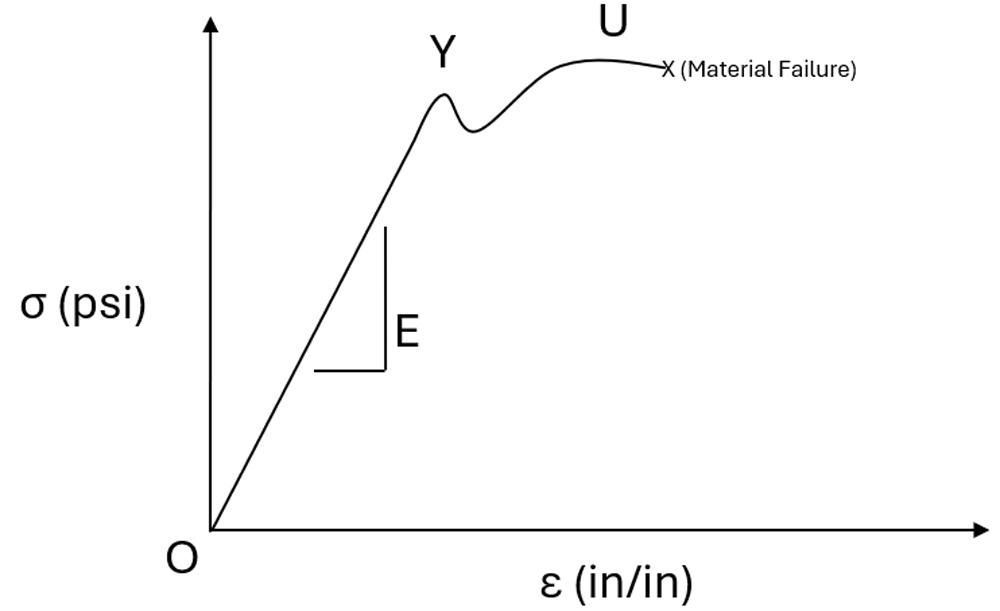
The slope of the line from the origin (O) to the yield strength of the material (Y) is a documented material property called Young’s Modulus (E) which can be found in any basic engineering textbook. Therefore, the relationship between a force which generates stress and the strain is linear (or Hookean), in that the slope of the straight portion of the curve (E) is simply the quotient of the stress and strain, or E = σ / ε. Rewritten, we have a general form of Hookean behavior, or σ = E∙ε, where the strain (like the displacement “x” in Hooke’s Law) is produced by a displacement from a force acting upon the specimen (E) (like the constant “K” in Hooke’s Law) is a property of the material, and stress (like the force “F” in Hooke’s Law) is a result from the strain.
This relationship is important, because it helps us evaluate the filling of an air-free pipeline. Once the pipeline is fully developed with fluid, we expect a linear response from additional fluid added to the pipe, which stretches the pipeline. That linear behavior is important in evaluating the pressure-volume (P-V) plot that should be generated during filling.
Pressure and temperature behavior in a closed system. Once isolated and pressurized, a hydrostatic test segment behaves as a near isochoric closed pressure, volume and temperature system. Pressure changes are often driven by temperature which, not surprisingly, can mask even small leaks. The physics is straightforward:
- Increasing temperature increases pressure
- Decreasing temperature decreases pressure.
Buried pipelines exhibit thermal lag relative to ambient conditions. Pressure trends should be evaluated against buried pipe temperature, not air temperature. A key engineering check is whether pressure changes follow the expected temperature trends. Trends that do not follow expected behavior should be thoroughly evaluated for the root cause of the physical deviation.
Instrumentation and metrology. Hydrostatic testing is fundamentally a measurement exercise. The reliability of the test depends on the accuracy, precision and traceability of the instruments used to measure pressure, temperature and volume (TABLE 1).
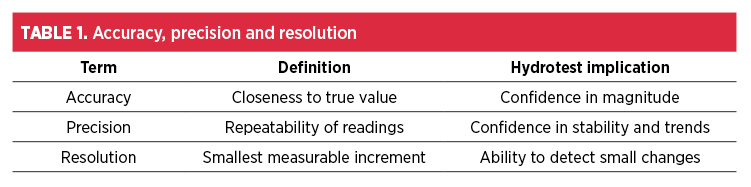
If leak evaluation requires pressure stability within ± 5 psi, an instrument that records in 10-psi increments should not be used to support the acceptance decision regardless of calibration accuracy.
Measurement uncertainty from multiple instruments combines and must be smaller than the allowable acceptance tolerance. If uncertainty approaches the allowable pressure or volume change, the test results may be inconclusive or not pass (TABLE 2).
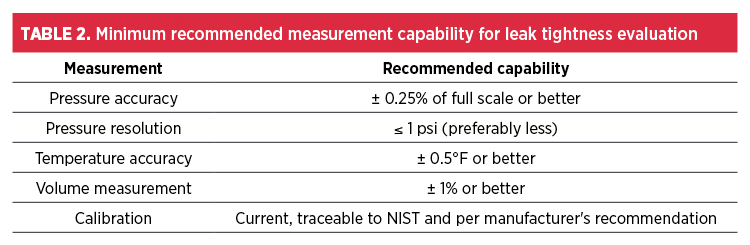
Measurement capability should be significantly better than the acceptance tolerance to support a defensible evaluation.
CIRCULAR CHART RECORDERS AND CALIBRATION INTEGRITY
Circular charts remain the official pressure record under the CFR for hydrostatic tests and are the primary document used for engineering and regulatory acceptance. The chart is the official test record, but it must be interpreted critically when instrument calibration or measurement reliability are in question.
A pressure trace is only as accurate as the measurement system that produced it. When calibration status, instrument condition, improper instrument use or measurement consistency are uncertain, the chart must be evaluated for internal consistency and physical credibility.
Interpreting wide or low-resolution traces. When pen width limits readability:
- Use fixed chart geometry (pressure rings) as reference
- Evaluate the midpoint of the trace within short time segments
- Compare repeated deadweight setpoints for consistent radial position (pressure).
Deadweight consistency check. Deadweight testers produce known pressures. If a constant deadweight pressure is maintained, the circular pressure chart trace should remain at a constant position. A drifting trace under constant deadweight conditions indicates potential recorder drift, calibration error, measurement inconsistency or something nefarious. This should be investigated in real time to determine the root cause of the issue and avoid a failed hydrostatic test.
Trend validation. Even when absolute accuracy is uncertain, trends must be physically consistent:
- Constant deadweight must equal a flat chart trend (e.g., not losing or gaining pressure)
- Pressure changes should correlate with temperature
- Consistent deadweight pressure recordings should align with consistent chart pen trace pressures.
A key diagnostic condition is a constant deadweight pressure despite a changing chart trend, or vice versa. Until the issue is solved, the reliability of the pressure record is questionable and the test cannot be deemed successful.
Volume balance and expected expansion. Leak tightness evaluation requires comparing the measured make-up water volume (e.g., squeeze water) to an expected system expansion. The expected volume change includes:
- Elastic pipe expansion
- Water compressibility
- Temperature effects
- Expansion of test equipment.
Measured volume should be explainable by physics. Excess unexplained volume may indicate leakage, entrapped air or measurement error. Using the geometry of the pipe and the nominal wall thickness can provide a good volume estimation if the length of the pipe is properly calculated [not too difficult a task given links to a geographic information system (GIS) and keyhole markup language zipped (KMZ) files available in many company’s repositories]. Contractors should have this volume plus 15% extra available to accommodate for venting, purging and squeeze water.
Interpretation and acceptance criteria. A hydrostatic test demonstrates tightness only when pressure, temperature and volume data correlate and reconcile within expected limits. The engineering evaluation should confirm:
- Pressure maintained within tolerance
- Pressure changes correlated with temperature
- Stabilization achieved
- Total make-up volume within calculated limits
- No sustained unexplained loss.
Pressure stability alone does not demonstrate tightness. Volumetric loss calculations should be performed to prove that pressure changes (or lack thereof) correlate to the temperature of the pipe-water system.
Finally, acceptance criteria should be set before the hydrostatic test begins, not during or after. Creating rules during or after the test is analogous to playing a game and when it is over, explaining the rules are and that “I win.” This does not seem fair when expressed in those terms, yet sly operators often conduct hydrostatic tests then make up the rules, or in the case that the author began this article with, the operator changed the temperature data after the test was over.
Tricks of the trade, common field pitfalls and practices to avoid. While there are many honest hydrostatic testing contractors in the market today, there are, unfortunately, those contractors that are not looking out for the best interests of our industry. There are a few tricks of the trade that inexperienced hydrotest project managers should be on the lookout for. While this is not an exhaustive list of deceitful ways to pull the wool over the eyes of the unsuspecting paying operator, this section may provide some insight into just how tricky (and deceitful) some contractors can be.
While the motives of these inappropriate practices are beyond the scope of this publication, operators should beware and be on the lookout for bad hydrotesting actors who simply seek to produce successful hydrostatic test results at any cost. The list below details some practical ways to help identify and hopefully thwart each illicit action. The following are a few clever (or so they think) tricks of the trade:
- Spinning the charts
- Blunting the pen tip and improper chart resolution
- Entrapping air or improper venting
- Uncalibrated or improperly calibrated instrumentation
- Locking in pressure
- Deadweight mass mischief.
Spinning the charts. Circular chart recorders are the permanent record of a hydrostatic test required by PHMSA under Title 49 Parts 192 and 195 of the CFR. Therefore, if audited in the future, these charts will be reviewed for compliance.
The charts are made by a machine that spins a pre-printed paper circle in a temporal manner with a preprinted scale against a pen. The pen is constrained to move linearly along the radial direction of the chart. The pen’s radial movement is calibrated so that its position corresponds to the correct preprinted circle representing the pressure of the test. This is a very simple instrument.
However, once on test (e.g., the red pen reaches the correct pressure), the chart can be manually (and fraudulently) spun by simply rotating the chart by hand for a duration equal to the expected test time. This produces a “textbook” perfect red pen trace and the appearance of a perfect test for the record.
Preventing this is relatively easy. Operators should have a trained employee onsite who initials the charts (in an outer blank area not interfering with the pen trace) and places the date and time upon each chart (one test at a time) prior to the contractor placing the chart into the chart recorder. Then, periodically, the operator’s representative should ensure that it is the signed chart that is recording at various points throughout the test. After the test has ended, engineers can also check the chart by turning the chart over and examining the mounting hole for signs of wallowing that does not occur with normal machine operation. Usually, the hand spun charts will reveal signs of mischief by displaying a non-concentric wallowing out and the center mounting hole will appear non-concentric from having been spun manually—although this is not a flawless check (FIG. 2).
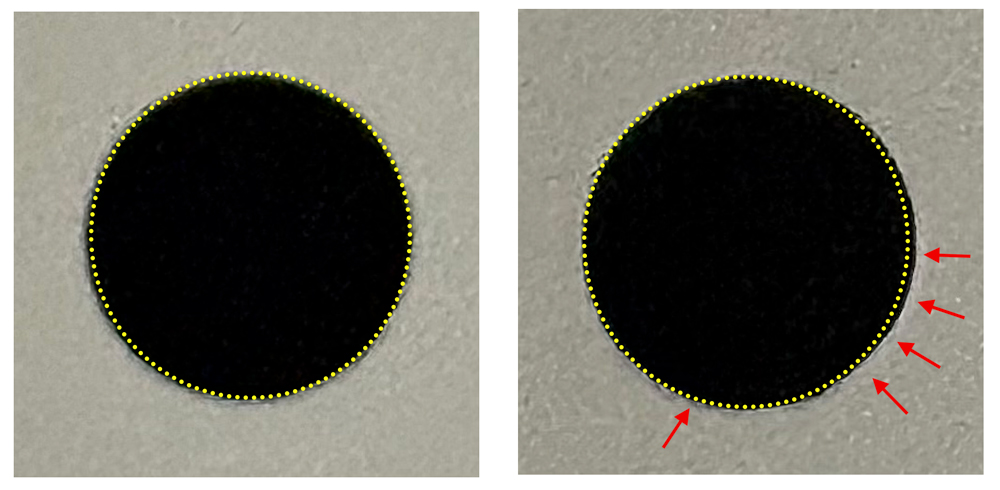
Finally, covering up the mounting hole with stickers or tape should be avoided. Preprinted charts have ample space for the time and date the chart was placed on and taken off, the instrument serial number, the location of the test and for remarks. Notes about abnormal pen movement from slammed trailer doors, bumping into the machine or table, or other anomalies should be clearly noted upon the face of the chart in legible writing as a permanent record of events occurring during test execution.
Blunting the pen tip and improper chart resolution. For an American National Standards Institute (ANSI) 600 system, the maximum allowable operating pressure/maximum operating pressure (MAOP/MOP) is typically around 1,440 psig. For systems with a 1,440 psig MAOP/MOP, a 0 psig–3,000 psig chart is appropriate so that the pen trace is near the center of the chart, leaving room for pressure increases or decreases. However, on most 0 psig–3,000 psig circular charts, the pre-printed concentric circles represent 50-psig increments. When the red pen trace takes up nearly half (or sometimes more) of the width of the distance between circles, something is wrong.
First, a newer chart recorder pen does not produce a wide pen trace from the manufacturer. In FIG. 3, the traces were produced from the same pen. The lower pen trace is from a pen from a new pack. However, pressing the pen tip hard against a solid surface widens the tip to produce the trace seen in the middle and upper pen traces. Why would a contractor want to do this? Well, simply ask yourself, did you notice that the pressure was falling in all three instances in FIG. 3? Look carefully again. Be critical of the gaps and the preprinted lines. Do you have your answer now? In short, a wide pen trace masks pressure changes creating the appearance of a “textbook” smooth curve. Don’t be fooled!
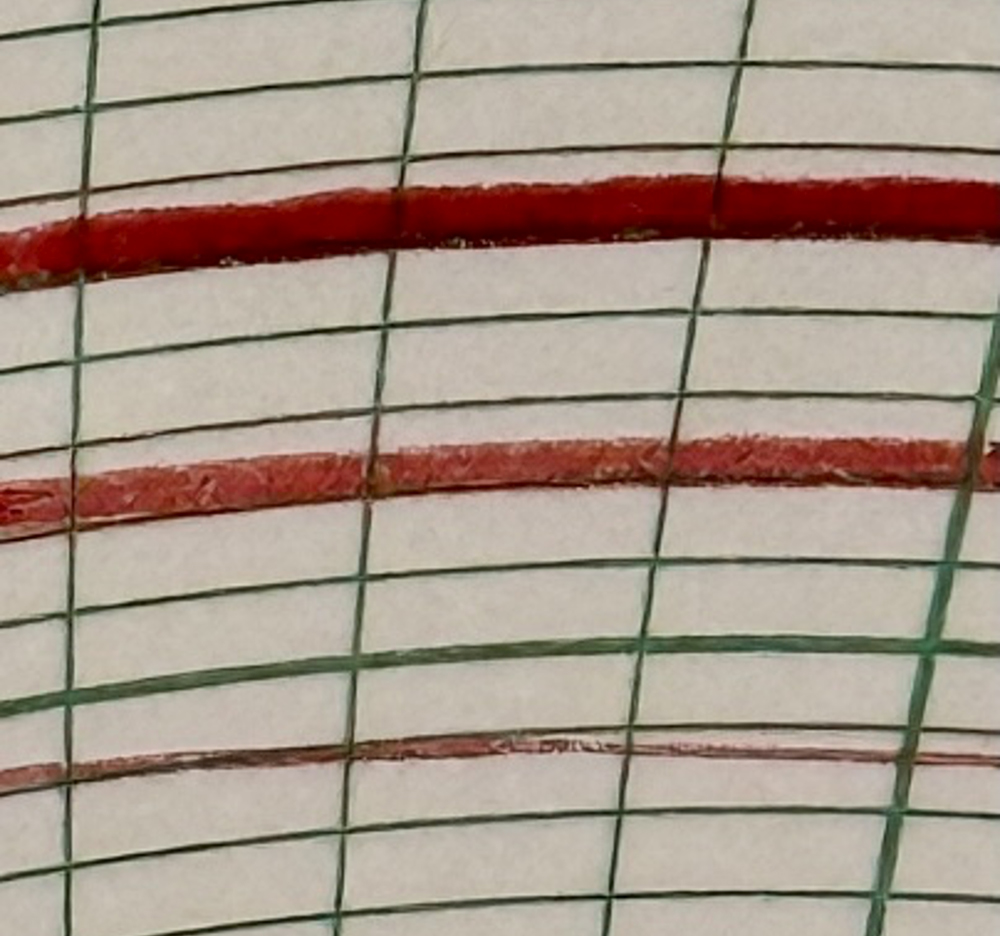
When the pen trace covers 16 psig, 20 psig or even 30 psig or more, contractors can mask smaller changes in the pressure and argue that the pressure meets the test parameters. This typically happens when hydrostatic test contractors seek to mask small leaks or pass a leak test where small changes are critical to success.
Another trick of the trade is using the wrong resolution. Typically, the best practice is that the chart range should be selected to place the red pen trace near the center of the chart. So, what if instead of 1,440 psig, the MAOP was 800 psig? The correct range for the chart is 0 psig–2,000 psig, not 0 psig–3,000 psig. Why does this matter? There are a few reasons.
First, the accuracy of most chart recorders is +/- 0.5% of the chart range. So, the accuracy of the 0 psig–3,000 psig chart range is +/- 15 psig, whereas the accuracy of the 0 psig–2,000 psig chart range is +/- 10 psig, which is significantly better.
Second, the resolution is important. The preprinted rings on the 0 psig–3,000 psig typical chart are divided into 50-psig increments, whereas the preprinted rings on the 0 psig–2,000 psig chart are typically in 20-psig increments. A wider pen trace makes reading the mark more difficult, but not impossible. All of these tricks are to disguise pressure movements during the hydrostatic test and give the charts the appearance of a better test. Remember, it is the chart, not the deadweight gauge, that is the official test record for PHMSA.
So, how do you avoid this? Well, again, it is imperative to have a qualified person onsite watching the test. Use the chart recorders to record the stabilization pressure: if you see a wide pen trace, nip it in the bud. In addition, demand that the chart pen be replaced. Chart resolution is a more difficult problem because this requires recalibration of the chart recorder, so it is best to decide what resolution you need in advance of the test. Simply write it in your hydrostatic testing plan so that all are aligned and know the expectations before the test begins.
Entrapping air or improper venting. From a physical standpoint, entrapped air introduces a spring-like energy storage mechanism into the system. As pressure increases, the air compresses, and as pressure decreases, the air expands. This spring-like behavior can mask smaller but continuous fluid losses, because leakage-induced volume loss may be offset by air expansion (like the spring expanding) without producing a proportional pressure drop. This occurs because the air follows the real gas law (PV = znRT) where the pressure (P) is proportional to changes in compressibility (a function of pressure and temperature) and the temperature itself. In other words, if the air temperature rises in the trapped air volume, pressure can increase. Similarly, if the volume of the air decreases, the pressure can increase (assuming no other parameter changes). This increase in pressure can mask smaller leaks, as demonstrated by the spring-like air expansion shown in FIG. 4B.
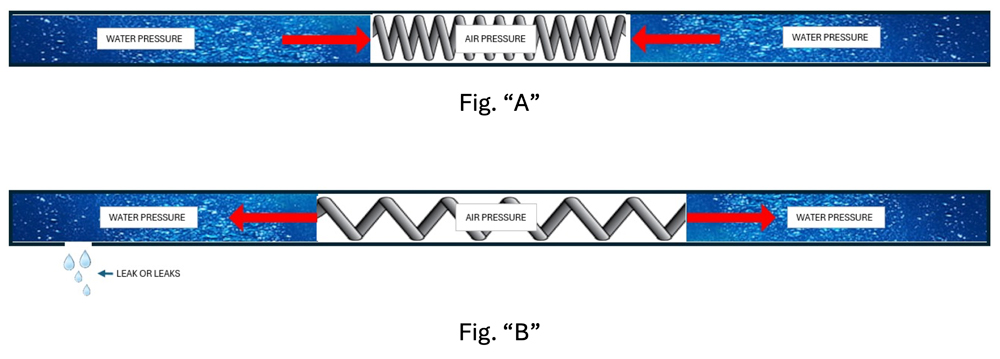
As a result, a pipeline with entrapped air may appear to maintain pressure even while water is escaping, particularly during long-duration tests or tests involving temperature fluctuations. This effect directly undermines the purpose of hydrostatic testing, which is to use pressure stability in an incompressible system as a proxy for leak tightness. FIGS. 4A and 4B illustrate an example of how air undermines hydrostatic testing.
API R.P. 1110 (FIG. 5) provides guidance for identifying trapped air during a hydrostatic test. It involves using the P-V plot.
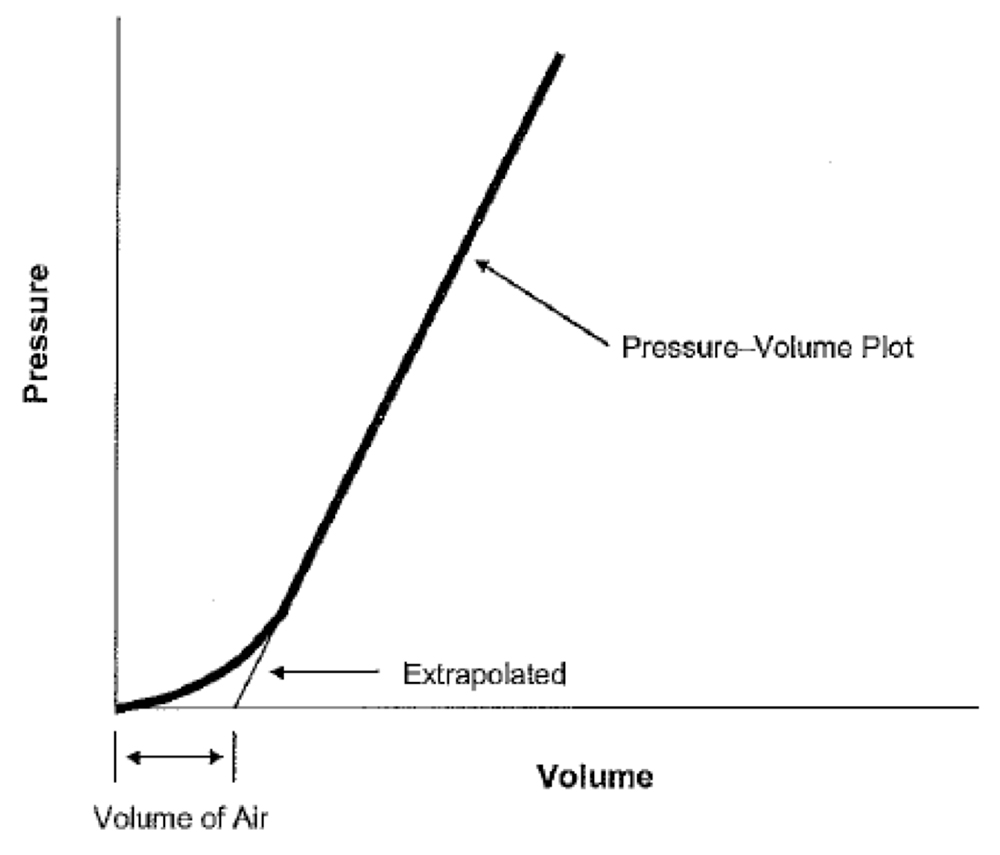
As the pipeline is filled using a positive displacement pump, each stroke of the pump pushes a fixed amount of water into the pipe. For example, if the pump produces 10 gallons (gal) per stroke and the operator counts 10 strokes, 100 gal of water were added to the pipeline (10 gal/stroke, 10 strokes = 100 gal). For each gal added to a full pipeline, the pressure should increase proportionally and follow a perfectly straight line. Why? Refer back to FIG. 1. Remember the Hookean behavior? That is why. The response to stress from pressure on the pipeline is linear if the stress remains in the elastic region (straight portion) of the stress-strain curve.
How do you know if you have gone too far? Well, we use the concept of “doubling the strokes.” When the number of strokes has doubled to produce the original linear pressure increase, then you are at or near the yield of the pipe. For example, if 10 strokes produced a 100-psig increase and now it takes 20 strokes to produce the same increase, that is too far, and you must stop immediately.
So, what happens when there is air in the line? The air compresses and the P-V line exhibits concavity up (it looks like a cup or “U” in the straight line). This can be seen more demonstrably at lower pressures, so it is important to start the P-V chart at the lowest possible pressure. As the air gets squeezed at higher pressures it can begin to act more like a liquid than a gas and may still make a straight line—or at least have the appearance of one. While concavity at higher pressure is still caused by trapped air, a straight line at higher pressures does not guarantee complete air evacuation—you need the P-V plot at the lower pressures to assist with that analysis.
Concavity on the P-V plot is also diagnostic and shows increasing pressure with less volume. This is a bad sign. It can mean that you have yielded your pipe or have a “soft spot” that is exhibiting yielding behavior. In short, your pipeline may be at imminent risk of rupture. This should be evaluated by a professional engineer immediately and no further pressure should be added until the anomaly is understood.
Uncalibrated or improperly calibrated instrumentation. Instruments must be calibrated according to the manufacturer’s instructions and be within the valid period established in the testing plan for calibration, but in no event more than 1 yr old. The best practice is to have instruments calibrated as close to the testing time as possible and usually within 6 mos of testing. A few tell-tale signs on calibration certificates can help flush out false calibrations or calibrations that are less than professional. A few of the warning signs are:
- An incorrect, incomplete or missing instrument model number or serial number
- A National Institute of Standards and Technology (NIST) traceable instrument with less accuracy and/or precision than the instrument being calibrated (e.g., using a digital gauge to allegedly calibrate a deadweight tester)
- Disclaimers that the calibration certificate cannot be produced without written permission from the calibrator
- Clarifications, exceptions or other disclaimers that render the certificate useless (e.g., this certificate only validates that the instrument is calibrated as operated during the calibration procedure)
- Non-independent calibrations (e.g., the instrument is calibrated by the owner of the instrument).
Because hydrostatic testing is primarily a metrological exercise, instrument calibration is critical to a valid and successful test.
Locking in the pressure. This is a trick of the trade that can be much harder to spot. Once the pressure of the pipeline is brought up to pressure and the circular charts and deadweight are up to the desired pressure, a ball valve is simply closed, trapping the pressure from the pipe in the small section of instrumentation and shielding it from any pipeline losses. This makes a perfect chart, and the deadweight and pressure chart rarely move from the ideal position.
FIG. 6 is elementary in that it does not show bleed valves (needle valves) and other manifolding. It is intended to highlight how pressure can be locked in to select instruments and give a false appearance of a higher pressure despite a leaking pipeline or leaking hydrostatic test equipment.
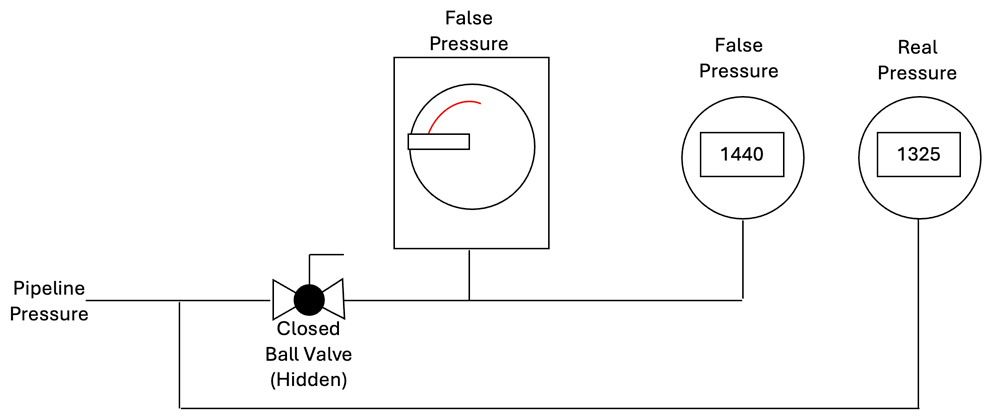
Preventing this is a bit harder as it takes a trained eye; however, there are a few signs that should make novice hydrostatic testers suspicious that this could be a possibility. The most obvious is the fact that the hydrostatic test operator must know that the pipeline has not ruptured during the test. They must have a relatively accurate reading somewhere of what the real pressure is. This means that novice operators should be skeptical of additional instrumentation recording pressure. For example, are there additional pressure gauges (digital or analog)? Are there multiple charts running? If the answer is yes, the inquiry is simple. Do they all have a similar reading? Calibrated instruments measuring the same thing should read the same or similarly. If they do not, immediate resolution and inquiry are mandated.
Deadweight mass mischief. What about the deadweight gauge or tester? Deadweight gauges and testers are not the same: if you do not know the difference, you may want to consider learning more about hydrotest instrumentation as that discussion is beyond the scope of this article. Nevertheless, the deadweight works on a generally simple principle. Pressure (P) is equal to force (F) per unit area (A): mathematically, P = F/A. In a deadweight assembly, P is the pressure of the pipeline, F is the effect of gravity on the masses that come with the deadweight instrument, and A is the piston area (FIG. 7).
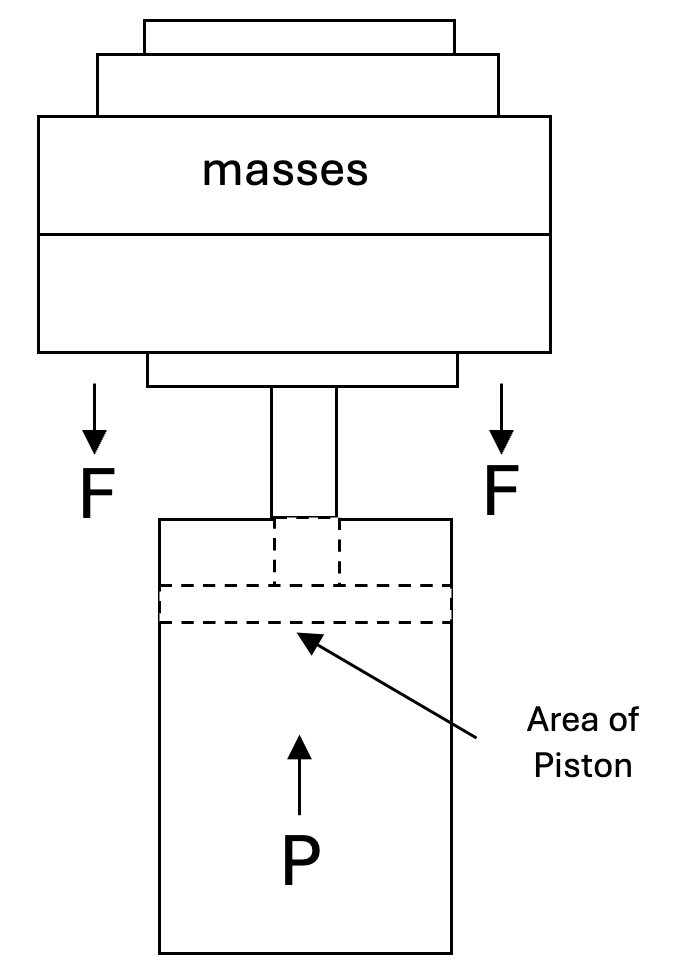
What could render such a seemingly simple device in error? First, the seal at the interface of the piston can leak or lose fluid. This reduces the pressure in the cylinder and reduces the masses needed to balance the pipeline pressure. Additionally, the acceleration due to gravity is directly down: if the deadweight assembly is not properly leveled, the reading will be off by a factor equal to the cosine of the angle of deviation. Next, the masses themselves (usually brass) can build up tarnish corrosion or be dropped and damaged. Regardless, they must be periodically revalidated with the device as per the manufacturer’s recommendations. Also, deadweight gauges and testers are calibrated at an average earth gravity of approximately 980.667 cm/sec². It is important to confirm the earth’s acceleration due to gravity at the testing location. For example, on mountains or in higher elevations, the force of gravity may be lower. Most deadweight testers and gauges come with equations to correct gravitational deviations at your site. It is recommended that those equations and corrections be performed by a licensed engineer.
Given the simplicity of this device, surely contractors cannot find a way to tamper with them, right? Guess again. Either intentionally or unintentionally, contractors have been known to machine (or turn) the masses to make them have less material. Sometimes this is to inadvertently remove damage or corrosion, with ignorance to the consequences. Other times, it is simply to deceive. Sometimes, contractors make brass masses or use other uncalibrated masses. Regardless, these improper actions can make the reading seem higher than they actually are, allowing the contractor to test at a lower and less risky pressure while reporting the testing at the higher pressure.
Again, having a qualified person onsite to check the masses and weights with a simple, cheap food scale can help verify that the masses are generally correct. In addition, ensuring that the pressure charts match the deadweight in both magnitude and trend is critical, as is resolving discrepancies before the test ends.
What a high-quality hydrostatic test looks like. A defensible hydrostatic test includes:
- Pre-test engineering calculations
- Verified and traceable calibration
- Redundant and consistent pressure verification
- Controlled stabilization period
- Continuous pressure and temperature recording
- Accurate volume measurements of fill and empty volumes
- Pressure, temperature and volume correlation
- Complete and appropriate documentation
- Independent sign-off, verification and acceptance by a neutral party.
Operational practices to consider include:
- Ensure instrument accuracy, precision and resolution before testing begins
- Remove all air from your system
- Resolve instrumentation discrepancies during testing, not after
- Instrument error invalidates testing
- Generate acceptance criteria before testing begins—not during nor after
- Be on the lookout for tricks of the trade
- Most importantly, be safe!
Takeaway. Hydrostatic testing remains a most reliable method for demonstrating pipeline integrity when properly executed and evaluated. However, hydrostatic testing should not contain “tricks.” The value of the test depends on measurement quality and engineering rigor. Three key principles summarize hydrostatic testing:
- Pressure alone does not demonstrate tightness
- Temperature effects must be understood and correlated
- Measured volume must reconcile with physical expectations.
Confidence in a hydrostatic test comes from physics, metrology, engineering calculations and documentation, and not from appearance.
ABOUT THE AUTHOR
TRAE J. MILLER III is the President and Chief Engineer of Kiefner and Associates Inc., a pipeline integrity and asset assurance firm that is regularly cited by PHMSA and other authorities. He has nearly 30 yrs of experience in pipeline engineering, integrity management, hydrostatic testing, safety and major capital program delivery. Miller’s career includes executive leadership roles in pipeline integrity for major operators and engineering firms across North America. He began his career in instrumentation and control systems engineering, where he specified and commissioned pressure and temperature measurement systems used in energy infrastructure. Miller has earned multiple Professional Engineering licenses in the U.S. and Canada and is licensed to practice law in Louisiana and Texas as well as before the U.S. Department of Veterans’ Affairs. Miller is also a Certified Safety Professional and holds credentials as a Program Management Professional and Project Management Professional. Miller is a 2026 inductee into Marquis Who’s Who of notable persons.
LITERATURE CITED
- Kiefner and Associates Inc., “DTPH5615T00009 development of comprehensive pressure test design guidelines—Task 4: Pressure test planning guidelines,” October 2018, online: https://primis.phmsa.dot.gov/rd/FileGet/12272/0339-1502_-_Task_4_Final_Pressure_Test_Planning_Guidelines.pdf
- Kiefner and Associates Inc., “DTPH5615T00009 development of comprehensive pressure test design guidelines—Task 5: Pressure test execution guidelines,” September 2018, online: https://primis.phmsa.dot.gov/rd/FileGet/12132/0339-1502_-_Task_5_Final_Pressure_Test_Execution_Guidelines.pdf
- Kiefner and Associates Inc., “DTPH5615T00009 development of comprehensive pressure test design guidelines—Task 7: Other considerations,” April 2018, online: https://primis.phmsa.dot.gov/rd/FileGet/12226/0339-1502_-_Task_7_Other_Considerations1.pdf