
Combined Surge, Seismic Loads Increase Stress Risks in Buried Pipeline Bends
V. K. KHANNA, Engineering Consultant, Gurugram, India
(P&GJ) — Cross-country large diameter gas pipelines pass through various stretches of landscape, covering varying ground conditions and soil strata. Pipelines in challenging locations with marshy and/or soft soils face unique risks, particularly when surge and seismic effects occur simultaneously, leading to high stresses at bends and vulnerable soil-pipe interfaces. For such compelling situations, a study was conducted to understand the vulnerability and risks involved for the safety of the pipe. A finite element (FE) model of a quarter pipe bend was developed to study these combined effects. The results show that surge-induced pressures and seismic loads concentrate at the point of pipe-soil contact, while surrounding soil layers dissipate multiple stresses effectively. These findings provide clear guidance for operators and designers, highlighting the need for targeted reinforcement of bends and soil support measures in multi-hazard environments.
For operators, these conditions represent a high-consequence scenario, since failure at a bend can trigger leakage, fire hazards, service interruption and costly repairs. This article introduces a bid-level screening framework that allows contractors, designers and owners to recognize these combined hazards early—even when detailed soil or seismic data are unavailable. The method draws on parametric ranges and shows how stresses at bends can be amplified well beyond what single-hazard checks would predict.
Pipeline risks in marshy terrain. Marshy soils are characterized by low shear stiffness, high groundwater tables and poor drainage. Under seismic shaking, such soils may lose strength or undergo large deformations. Pipelines buried in these zones are vulnerable to relative displacement, ovalization and uplift.
Large-diameter pipeline bends in marshy areas present a unique and complex situation under water hammer conditions, as a combination of high transient pressure forces, soil-structure interaction effects and the limitations of unstable soil are simultaneously encountered. The unstable, saturated soil provides little support and damping, exacerbating pipe vibration and movement, especially at bends where forces are concentrated.
Pipeline bends and elbows are especially sensitive because they experience unbalanced thrusts whenever internal pressures fluctuate. A surge event, caused by a sudden valve closure or compressor trip, produces a transient pressure rise that is magnified at elbows.
Earthquake shaking is assessed using IS-1893 and guidelines of Seismic Design of Buried and Offshore Pipelines.¹ A study by the Multidisciplinary Center for Earthquake Engineering Research further complicates the picture.² Ground motions and permanent ground deformation (PGD) can strain pipelines axially and transversely. In soft soils, lateral spreading and pore-pressure build-up reduce restraint, allowing bends to deform more severely.
When surge and seismic loads coincide, the stresses are not merely additive. The soil-pipe system behaves nonlinearly, and interaction effects can increase stress demands by 50% or more.
Design approach to mitigate the problem. Traditionally, pipeline hazards are considered in isolation. Surge or “water-hammer” events are treated separately from seismic ground shaking, while soil conditions are assumed from generic classifications. However, reality is rarely so simple. A sudden pressure surge in a pipeline during an earthquake—especially where the pipe bend is buried in marshy soil—creates a multi-hazard scenario with the potential for overstressing and even failure.
The mechanism of resolution involves the use of Joukovsky relation and Finite Element Technique.
SURGE LOAD MODELING
Surge-induced pressure rise is estimated using the Joukowsky relation:
ΔP = ρ a ΔV
where ΔP is the pressure rise (MPa), ρ is the fluid density (kg/m³), a is the acoustic wave speed in the fluid (m/sec)—modified as needed to account for pipewall elasticity—and ΔV is the instantaneous change in fluid velocity (m/sec) from valve closure or compressor trip. The transient internal pressure at the elbow is then prescribed as a time-dependent load on the inner pipe wall. The resulting unbalanced thrust at the bend is transmitted to the surrounding soil through the soil-pipe interface. In the numerical cases, surge magnitudes of 1.5 MPa–3 MPa were paired with peak ground accelerations (PGAs) of 0.20–0.35 g, to explore multi-hazard interaction.
FE method. The FE method is a good design tool to analyze the combined effects of surge in pipe, seismic load by ground motion and surrounding soil pressure. To better understand this interaction, an FE model was developed for a representative pipe bend embedded in soil. The model combines surge-induced internal pressures with seismic ground motion effects, while also accounting for the surrounding soil mass and boundary conditions.
FIGS. 1 and 2 simplify the methodology of input for analysis and the results obtained.
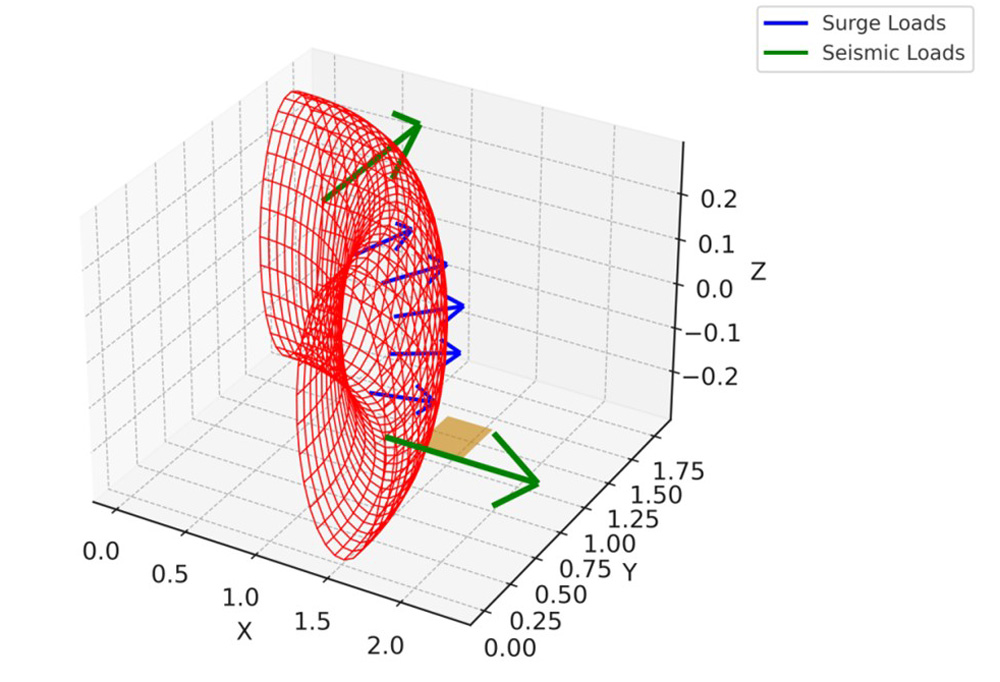
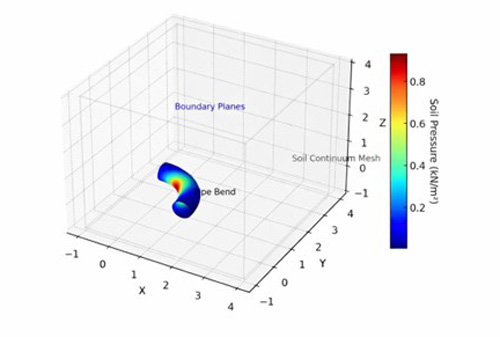
FIG. 1 shows a three-dimensional (3D) FE representation of a buried steel pipeline with a 90° bend [an outer diameter (OD) of 1,000 mm and a wall thickness of 25 mm]. The loading/actions shown include internal pressure (P = 5.5 MPa) associated with surge/flow, seismic excitation, soil-pipe interaction (brown patch) represented as distributed soil reaction/restraint and buoyancy (uplift). FIG. 1 is presented in schematic FE model view; it is not to scale.
FIG. 2 shows the results of analysis. Soil pressure contours around the pipe bend highlight areas of high stress concentration and dissipation into the surrounding soil.
DISCUSSION AND RESULTS
The soil pressure distribution shown in FIG. 2 indicates that the 90° pipeline bend behaves as a strain-critical location under combined internal pressure (5.5 MPa), soil restraint, seismic excitation and buoyancy effects. In line with the intent of ASME B31.12, the interaction of membrane stress, bending-induced curvature effects and imposed ground movement results in non-uniform localized soil reaction, which is not yielded by straight pipe or single-hazard design checks.³
Concentration of soil pressure at the bend region is noticed. Compared to the adjoining straight segments, the bend exhibits higher and more non-uniform contact pressures. This occurs because the curvature introduces radial deformation demands, forcing the pipe wall to require additional soil resistance to satisfy compatibility between the pipe and surrounding ground. The concentration of soil pressure at the bend intrados (inside of elbow) and crown regions reflects the combined influence of pressure-induced axial force and curvature-related bending. This is consistent with strain-based design principles adopted for hydrogen (H₂) and high-consequence pipelines. These results support the need for explicit, 3D soil-pipe interaction analysis for bends subjected to multi-hazard loading, as envisaged in the performance-based provisions of ASME B31.12.³ The asymmetric pressure distribution around the bend circumference—noticed during analysis—aligns with ISO 13623 soil–pipe interaction concepts.⁴
Rapid decay of pressure away from the bend takes place. Moving away from the curved segment into the straight portions, the pressure contours become more uniform and of lower magnitude. This confirms that the bend acts as a local stress amplifier, while straight segments primarily transmit loads without significant local interaction effects.
Takeaways. The study confirms that bends in buried pipelines are critical stress points when surge and seismic effects act together, especially in marshy or soft soil conditions. Soil pressures peak at the pipe-soil contact zone, but the surrounding soil continuum dissipates these loads effectively, reducing far-field impacts.
For pipeline operators and designers, the lesson is clear: reinforcing bends and improving local soil support can greatly enhance resilience in multi-hazard environments. FE modeling provides a practical way to predict high-stress areas and guide reinforcement strategies before failures occur.
Recommendations for owners and operators include:
- Require bidders to demonstrate consideration of combined surge–seismic effects in marshy terrains.
- Encourage inclusion of mitigation provisions in early contracts to reduce risk exposure.
Recommendations for design engineers include:
- Prioritize bends in marshy soils, for deeper burial or protective encasement.
- Include surge suppression devices (air chambers, surge tanks) in high-risk zones.
- Refine bid-level assumptions with site-specific geotechnical and transient hydraulic data in the final design phase.
Practical takeaways. Pipe bends in marshy and/or soft soils are the most vulnerable points under gas surge pressure and seismic loads. Soil pressure peaks at the pipe-soil contact zone but dissipates outward into the surrounding soil. Reinforcement of bends and improvement of soil support can significantly reduce risk. FE modeling is a practical tool to predict high-stress zones and guide cost-effective mitigation.
LITERATURE CITED
- Bureau of Indian Standards (IS) 1893, “Criteria for earthquake resistant design of structures—Part 1 General provisions and buildings, 6th Rev., 2016.
- O’Rourke, T. D. and X. Liu, “MCEER Monograph 3—Seismic design of buried and offshore pipelines,” Multidisciplinary Center for Earthquake Engineering Research (MCEER), University at Buffalo, New York, 2012.
- American Society of Mechanical Engineers (ASME) B31.12, “2025—Hydrogen Piping and Pipelines.”
- International Organization for Standardization (ISO) 13623, “Petroleum and natural gas industries—Pipeline transportation systems,” 3rd Ed., 2017.
About the Author
VIJAY KUMAR KHANNA has 50 yrs experience in engineering projects, 26 yrs of which were in the oil and gas sector while working with Engineers India Ltd. (EIL) until March 2001. He worked for Engineering Review of the Jumbo LPG I plant for Sonatrach in Algeria, was the Project Engineering Manager for the first hydrocracker plant in India and was the Project Manager for a grassroots refinery at Numaligarh, the BPCL refinery expansion at Mumbai and several revamps. Khanna has been published in leading international industry publications, including Hydrocarbon Processing in 2001 and 2024, and H₂Tech in 2023 and 2025, as well as AJCE in 2026. Khanna has earned a B.E. degree in civil engineering and a PGD in management.