
SCADA Systems Face Spectrum, Compliance and Long-Term Stability Challenges
M. LEE, Mona Lee & Associates LLC, Houston, Texas (U.S.)
(P&GJ) — For many years, supervisory control and data acquisition (SCADA) communications systems operated in a relatively stable environment. Systems were well understood, deployment models were predictable and regulatory requirements generally aligned with how these systems were built and maintained in the field.
That stability has somewhat shifted. The implications extend beyond engineering into licensing assumptions, equipment choices, siting considerations and how long-term compliance is evaluated. Understanding where those implications might surface, and addressing them early, helps avoid unnecessary friction later. The author has seen more than one system treated as permanent simply because it had operated quietly for years.
What is actually different about SCADA systems now. At its core, SCADA has not changed. It still monitors, controls and reports. What has changed is how the communications supporting those functions are selected, deployed and expected to hold up over time.
Many systems are now designed with the expectation that they will remain in place for decades, even when operating in shared or constrained spectrum environments. Equipment is purchased with long service lives in mind, and communications paths are often treated as permanent, whether or not the underlying spectrum supports that assumption.
That gap—between how long systems are expected to operate and the regulatory status of the spectrum they rely on—is where problems begin to surface.
Where SCADA runs into regulatory reality. Issues tend to arise when systems are installed with the expectation that they will operate indefinitely, even though the spectrum or licensing framework does not support that level of permanence. These issues are not the result of non-compliance; they surface when older regulatory assumptions meet the way systems are actually built and used today.
A real-world example: Licensed secondary use in the 217 megahertz (MHz)–219 MHz band. This became very real when the author received a panicked call from a vendor whose client, operating in the 217 MHz–219 MHz band, had received a notice that some interference might need to be resolved. This system had been licensed and in use without issue for years. Nothing about the equipment had changed. What changed was the spectrum around it.
For many years, this band has been used successfully for SCADA applications, often by combining adjacent narrowband channels to achieve workable bandwidth. From an operational standpoint, those systems appeared stable and permanent. The vulnerability tends to surface later—not at installation and not at licensing. Instead, it surfaces when something else changes.
In this case, the spectrum involved traces back to automated message transmission system (AMTS), a primary service that has existed in and around the 217 MHz–219 MHz band for decades. Over time, portions of this spectrum were made available for other uses in the interest of spectrum efficiency, allowing secondary data and control operations to coexist. While those secondary uses were licensed and operated successfully for years, the underlying primary rights remained.
The lesson is not that the 217 MHz–219 MHz band is unsuitable for SCADA, but that licensed does not mean protected, and secondary does not mean temporary in practice, until it suddenly does. Early understanding of that distinction allows operators to weigh long-term risk appropriately before committing to equipment that assumes permanence.
What to clarify before purchasing SCADA communications equipment. As SCADA systems become more complex and are expected to operate longer, procurement decisions carry consequences that extend well beyond equipment specs. Vendors focus on capability and performance. It remains the operator’s responsibility to confirm that systems can be deployed, and kept in service, within applicable regulatory and spectrum constraints.
Before committing to significant purchases, operators benefit from confirming several fundamentals, including:
- Regulatory status of the frequency band
- Spectrum availability in the intended service area
- Duration assumptions, including any waiver requirements
- Bandwidth constraints and aggregation needs
- Responsibility for mitigation if frequencies must change post-deployment.
These are not new considerations, but they are often overlooked when equipment decisions are made in isolation. Addressing them early helps avoid situations where systems must be modified, retuned or relocated after they are already in service.
A related consideration is the use of unlicensed microwave links in support of SCADA and operational systems. While these solutions can be attractive from a deployment and cost perspective, they carry no interference protection. In highly congested environments, such as the oil patch, unlicensed paths may be subject to persistent interference from other users operating in the same spectrum. In those settings, system reliability depends less on regulatory standing and more on real-time spectrum conditions, which change as activity in the area increases.
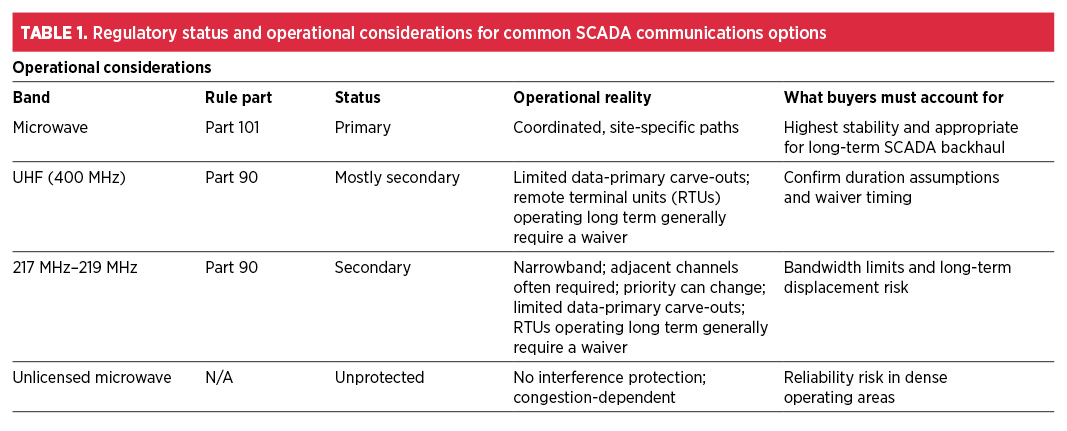
Condensed technical truth. SCADA deployments today operate under different regulations depending on the frequency band in use, and those distinctions affect long-term stability. Under Part 101, SCADA operations are primary, providing a level of assurance that differs materially from most Part 90 environments. Within Part 90, the ultra-high frequency (UHF) band includes a limited set of low-power channels designated specifically for data use. However, the majority of SCADA operations remain secondary and subject to coordination and displacement.
In addition, the extended operation of remote stations under Part 90 typically requires a waiver, which is routinely granted but must still be requested and documented. Other Part 90 options, such as the 217 MHz–219 MHz band, introduce further constraints, including narrowband channels and the need to combine adjacent channels to achieve sufficient bandwidth. These regulatory distinctions should be understood before equipment is selected or purchased. TABLE 1 shows SCADA communications and operational considerations.
Stability still matters. Despite ongoing technical advances, one constant remains: SCADA systems depend on stability. Operators plan for long lifecycles, predictable performance and minimal disruption.
Regulatory clarity supports that stability, as do thoughtful alignment between system design, spectrum choice and long-term compliance expectations. Modernization does not require abandoning predictability.
With informed planning and realistic assumptions, operators can adapt to changing communications environments while preserving the reliability their systems are designed to deliver.
About the author
MONA LEE is principal of Mona Lee & Associates LLC, providing U.S. Federal Communications Commission (FCC) regulatory consulting services to utilities and energy companies. She has more than 30 yrs of experience supporting SCADA, microwave and land mobile radio systems.