
AI-Powered ROW Intelligence Transforms Pipeline Integrity Across Land, Air and Space
M. J. SCOTT, Innovation Contributor, Northern Pixels
(P&GJ) — After decades of incremental improvements in rights-of-way (ROW) integrity monitoring, artificial intelligence (AI) is catalyzing a fundamental shift in how operators detect threats, analyze data and protect critical infrastructure.
“I see innovation as being willing to question legacy assumptions, apply best practices and make data-driven decisions faster,” said Jamie Chapman, Senior Vice President of Technical Services at Colonial Pipeline—the U.S.’s largest refined products pipeline by volume, moving more than 100 million gallons (MMgal) of fuel daily across the Southeast and East Coast. “I am a relentless pursuer of continuous improvement—this moment is helping accelerate those abilities.”
That philosophy is reshaping how North America’s largest pipeline operators approach ROW integrity. At Kinder Morgan, where pipelines transport approximately 40% of the natural gas consumed in the U.S., Chief Operating Officer James Holland sees AI as an enabler (FIG. 1). “What is changing is the maturity and availability of data, along with our ability to analyze and turn it into something that’s more actionable,” Holland explained. “AI is progressively allowing us to connect more data across multiple sources in more practical ways than before, and I can see this transformation will get increasingly better over time.”
From compliance to intelligence. The evolution of aerial patrol technology exemplifies the transformation of surveillance. For decades, pipeline operators have conducted visual inspections of their ROW—typically biweekly flyovers during which trained observers scan for encroachments, excavation activity, leaks and environmental changes. This regulatory requirement has been a backbone of ROW integrity, but it is constrained by human limitations.
“ROW flight paths are long, and human observers get tired over time,” noted Eric Bergeron, CEO of Flyscan, whose AI-powered aerial inspection systems now fly on Colonial, Kinder Morgan and other major operators’ patrol aircraft. “AI will never grow tired; it will always perform in a predictable way.”
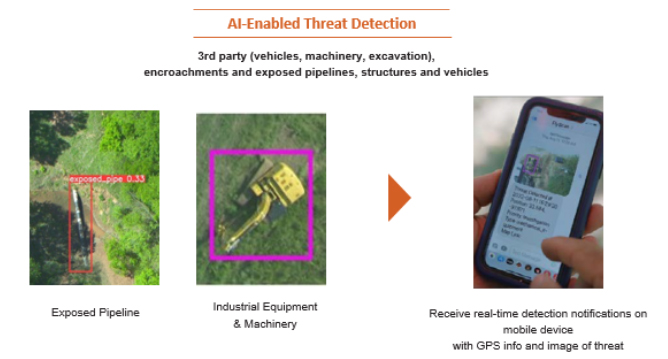
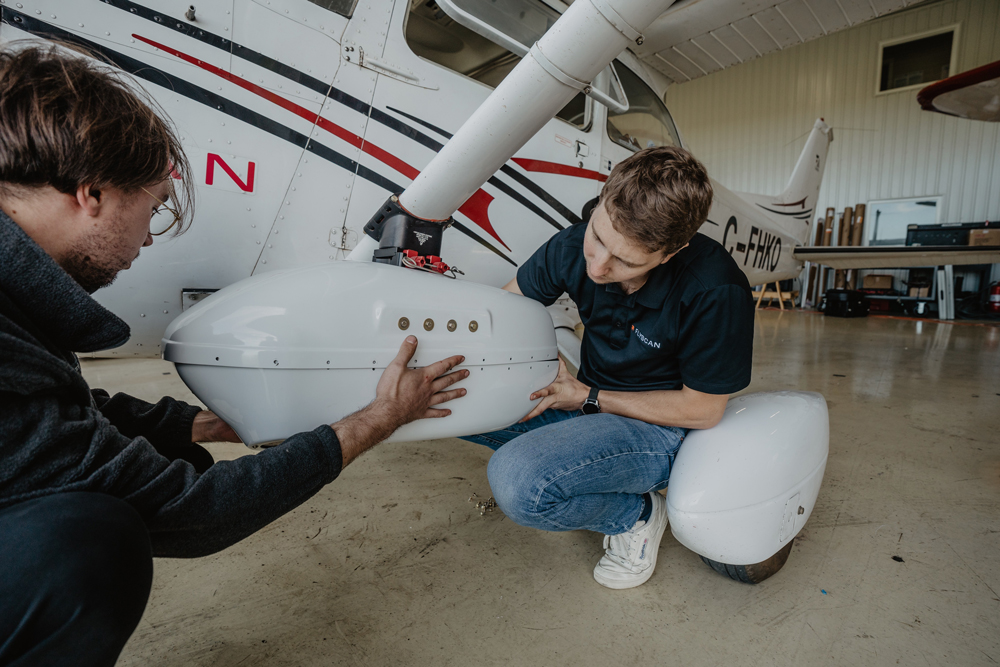
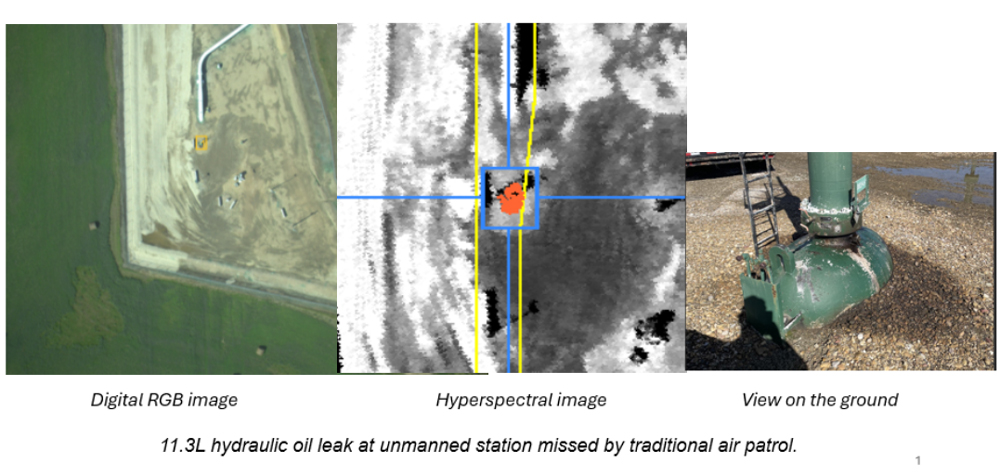
Flyscan’s technology transforms traditional patrol aircraft into sophisticated data collection platforms. Hyperspectral cameras identify leaks invisible to the human eye and hi-resolution digital cameras capture ROW imagery processed by proprietary AI models trained on millions of labeled images to detect threats in real time. The system identifies everything from excavators and bulldozers—the most immediate threats to pipeline integrity—to slower-developing risks like erosion, vegetation encroachment and unauthorized structures (FIG. 2).
“When we decided to prioritize detection categories, we asked our customers: what do you want first?” Bergeron recalled. “Number one was to detect anything that can damage the pipeline in real time. Any presence of third-party encroachment became our priority. As our capabilities became more powerful and reliable, we began adding layers, including seeper leak and geohazard detection.”
The economic benefits are measurable. Flyscan customer feedback examples demonstrate a customer saving $750,000 per leak incident, another showing > $2 MM in annual vegetation management savings and another reporting 30%–50% fewer manual inspections required.
For Colonial, the adoption of AI-enhanced aerial inspection represents a strategic evolution. “We have been working with hyperspectral technology for three years now,” Chapman said. “We took a serious step of really changing some of our programs to have that more deeply implemented and we are excited about what we are seeing. We are focused on reliability, on trust, and so far in all the testing that we have done with Flyscan’s hyperspectral imaging, it has been tremendous. While there is no single silver bullet for leak detection and prevention, it is a layered strategy, and Flyscan is a very good tool to have in our arsenal.”
The power of connected data. An emerging transformation of ROW integrity lies in how operators are integrating multiple data streams into comprehensive integrity practices.
“In addition to Flyscan, we also have a close relationship with NDT Global and have been using Environmental Systems Research Institute (ESRI) for quite some time,” Chapman confirmed. “There are emerging opportunities, and we are at the stage of exploring and leveraging all three of these solutions’ unique data capabilities to create sophisticated layered data sets to drive better operations.”
This convergence of technologies—in-line inspection (ILI) data, geographic information systems (GISs) mapping and aerial monitoring—creates opportunities that did not exist a few years ago (FIG. 3). At Kinder Morgan, Holland saw this potential when the company invested in Flyscan, initially for methane detection capabilities. “We were very interested in Flyscan and became an investor because of its potential methane detection for the natural gas side,” Holland explained. “That same hyperspectral camera technology is good for picking up liquid seeper leaks on liquid lines. We are now expanding the Flyscan roll-out, and it is adding more actionable information into our stack.”
This cross-pollination of innovation across Kinder Morgan’s business units has become a deliberate strategy. “Five years ago, when I took this role, we really integrated those four business units to make sure that information and lessons learned get spread across the organization,” Holland noted. “That cross-pollination really helps you innovate and grow. With the accelerated effects on how AI is helping bring more actionable data, this strategy will pay off for integrity and operational efficiencies.”
AI enhancing traditional inspection. ILI technology has been detecting pipeline anomalies for decades, but AI is improving how that data gets analyzed and acted upon. Thomas Hennig, CTO at NDT Global, describes the challenge as, “We are collecting massive amounts of data from every inspection run. The question has always been: how do we turn that data into actionable intelligence faster and more accurately?”
NDT Global’s AI capabilities focus on improving pattern recognition across its global database of inspection data, particularly for crack detection in liquid pipelines, where the company maintains one of the industry’s deepest data sets. “When we detect something new, a new kind of threat, it gets fed back into the system, and what we learn from one pipeline benefits operators everywhere,” Hennig explained. “We don’t share customer-specific data, but generic learnings about defect types, material behaviors or environmental factors become part of our detection capabilities.”
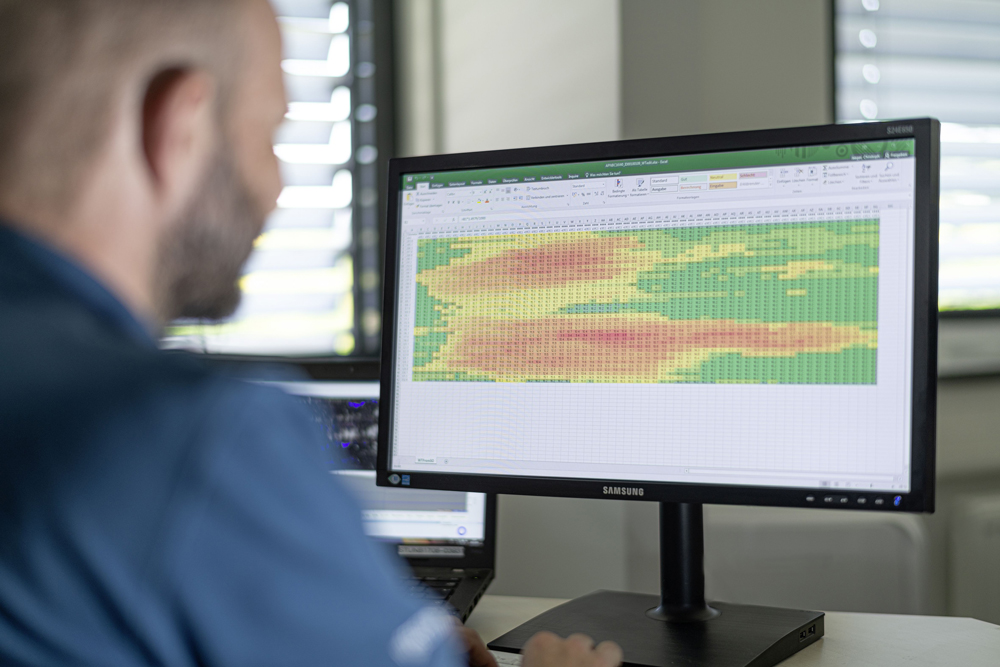
This approach enables NDT to identify correlations between pipeline materials, operating conditions and defect patterns across their entire customer base. If a specific grade of pipe exhibits corrosion characteristics in certain climates, that intelligence helps predict and prevent issues in similar pipelines elsewhere. This capability reduces false positives and prevents unnecessary excavations that cost operators hundreds of thousands of dollars per incident (FIG. 4).
However, Hennig emphasizes that AI augments rather than replaces expert judgment. “Especially when it comes to significant anomalies we are going to report, there is always a human factor on top,” he stressed. “The experienced analyst must check AI-generated results and verify the suggestions are correct. It is not an automated process that triggers action without human interface, but it already helps us accelerate identifying risks.”
Chapman echoes this philosophy at Colonial. “AI is not a replacement for engineering judgment or field experience. The best use for AI now—and in the future—is augmenting the capabilities and experience we already have, helping us make better and more data-driven decisions.”
Geographic intelligence at scale. While inspection and monitoring technologies generate granular asset data, GISs provide an enterprise framework that makes that data more operationally accessible. Jeff Allen, ESRI’s Global Pipeline Practice Lead, noted that virtually every major North American pipeline operator runs on ESRI’s platform, but most have not yet fully tapped its AI and enhanced spatial analytics capabilities.
One emerging AI workflow is focused on solving one of the pipeline industry’s most persistent challenges: verifiable and traceable documentation. Operators must prove that critical GIS attributes are supported by source records. However, those records are often fragmented across decades of paper drawings, legacy computer-aided design (CAD) files, scanned reports and project documentation. AI-assisted workflows now make it possible to automatically discover, classify, extract and link historical documentation to GIS features to ensure that the data that supports regulatory compliance, integrity management and enterprise decision-making is as accurate as possible.
“Companies are asking us: can we create an AI agent around documents and have it find a hydrostatic test that references a specific line in this pile of documents?” Allen explained. “It is like finding a needle in a stack of needles. AI agents can search through historical data, identify gaps and locate documents that might fill those gaps—work that would take engineering teams years to complete manually.”
ESRI is also applying AI to predictive maintenance and risk analysis. By correlating GIS data with population density, land use changes, construction permit activity and environmental factors, operators can identify areas where potential threats are increasing before incidents occur. “What is really holding companies back is not that they don’t have the data—they don’t have the metadata that properly describes what that data is,” Allen noted. “AI will not understand it until we describe what it is, how that correlates to risks along the pipeline and ultimately to implementing barriers to those risks before they impact the assets. That is what everybody is working towards now.”
Chapman sees this potential clearly. “When you look at all the different data sets we have available on the pipeline integrity side—one-call volume, population growth, construction activity—those areas with a lot of one-calls could mean there are a lot of people digging, meaning that the risk for third-party damage to our assets is trending up in a specific area. Maybe we need to deploy more foot patrols or more aerial patrols. Having access to that data, being able to interpret it and tying those indications together are difficult to do without innovation and superior data management.”
Real-world applications and measurable impact. The practical benefits of AI-enhanced ROW integrity are becoming measurable across multiple dimensions. Traditional aerial observers might conduct a visual inspection and note general observations in post-flight reports. AI-powered systems can detect, classify and geo-locate potential threats in real time, and integrate with ticketing systems to make detections actionable by field teams.
For vegetation management alone, the efficiency gains are substantial. “If you are flying that ROW twice a month, over time you can predict when you need to schedule crews to go out and cut back vegetation based on actual growth rate information,” Holland pointed out. Predictive scheduling optimizes crew deployment and reduces emergency response costs. The Flyscan technology also enables class location verification, determining whether population density changes along a pipeline route require different operating pressures or additional safety measures.
Overcoming implementation challenges. Despite the promise, operators acknowledge that implementing AI capabilities is not without challenges. Cultural acceptance, data quality and integration complexity all require careful management.
“There remains a perception that AI equals a black box,” according to Hennig. “If something is incorrectly assessed, it is very difficult to justify why this black box came up with a particular result. Repeatability and consistency are challenges we must overcome by having man and machine work together.”
Chapman emphasized discipline around risk. “We are very intentional about giving our teams permission to evolve processes and test new tools, but innovation is not the goal—focusing on desired outcomes is. Protect the public, protect the environment, protect our system and operate reliably.”
Data standardization presents another hurdle. Many operators have decades of legacy data in inconsistent formats. Holland described the challenge: “The first step is data quality. If you have information and it is just gibberish, you cannot fix that problem before you can use it. We are trying to figure out what are the real parameters for good data quality so that we can take the information and start to use it. AI should help us on this strategic journey.”
The challenge of training AI models for highly variable environments also requires substantial datasets. “Threats along the ROW come in many forms, and some are extremely rare in real-world conditions,” Bergeron explained. “Environments vary from open fields to rocky terrain to dense urban areas, and they look completely different across four seasons. We are fortunate to have a fleet of units in operation, building one of the largest collections of aerial ROW imagery in the world. This lets us leverage far more imagery than what could realistically be labeled by hand.”
The collaborative future. Perhaps the most intriguing aspect of AI’s impact on ROW integrity is the potential for greater industry-wide collaboration on shared challenges. While pipeline companies compete for customers and routes, they face common operational threats and regulatory requirements.
“It is definitely challenging, but I am hopeful we will get over many of the industry hurdles someday,” Chapman said. “Imagine if we had satellite data with sufficient detail that covered multiple operators’ ROW. We could share information about threats that affect everyone (e.g., erosion, soil subsidence, unauthorized excavation activity). In the past, we have had field crews with another operator share information that an excavator or contractor was digging without a required permit on our ROW, giving us an important heads up. That cooperation is vital to our common ROW goals.”
Holland agrees that industry benefits from collective improvement. “When we were looking at our methane emissions for our sustainability report, we found a program at one of our splitters that gave real-time feedback on what was being emitted and how to control it. We think there is a way to use that at compressor stations to find leaks with Flyscan. Little things like that have a big rippling impact.”
Both operators emphasize that this is not about mandated data sharing, but rather industry associations facilitating voluntary knowledge exchange. “We have good discussions through the American Petroleum Institute (API), Pipeline Research Council International (PRCI) and Liquid Energy Pipeline Association (LEPA) about how we can collaborate,” Chapman noted. “The industry benefits from continuously improving public trust. If all companies keep the bar high and share best practices, it benefits everyone.”
Takeaways. As AI capabilities continue to advance, operators and technology providers alike see expanding opportunities. NDT Global is working on next-generation crack detection for gas pipelines, an area where inspection technology has been limited. “We are coming up with a new solution in cooperation with an operator,” Hennig revealed, “which is one of the biggest and most exciting developments at the moment at NDT.”
ESRI envisions AI agents working collaboratively across different data domains. “There is an agent around the GIS, an agent around documents, an agent around work order data,” Allen described. “How do we get these AI agents to talk to each other and solve complex problems? That is where we are headed.”
For Holland, the future is bright. “When you look at all the projects that we will be putting into service over the next three to four years, driven by enormous power generation demand, there is tremendous growth opportunity. The question is: are there things we have done in the past that AI could help us achieve in an improved and more efficient way? We must adopt a forward-looking approach and not just stick with what worked in the past.”
Chapman frames it in terms of operational imperative. “The expectation around our operating environment continues to grow—whether it is mitigating encroachment risk by third-party activity or response times anywhere on our system. Traditional inspection and patrol models may not be as effective as leveraging new tools. We must understand what new tools are available and ask: is this the best way to achieve our desired outcomes?”
The answer, increasingly, involves AI not as a replacement for proven integrity practices, but as an amplifier of human expertise, a connector of disparate data streams and an accelerator of the continuous improvement culture that has always defined pipeline operations at their best.
About the author
MARK M.J. SCOTT is the President of Northern Pixels, a strategic advisory firm serving technology companies in energy, AI and industrial sectors. His innovation articles have appeared in Forbes and AI Insider, and he has written white papers for global brands including Apple and Samsung.