

CCS Focus Turns to Integration, Not New Capture Technology
Carbon capture developers are shifting focus from new capture technologies to system integration, cost reduction and modular design, panelists said at CERAWeek.
By Mary Holcomb, Digital Lead
HOUSTON (P&GJ) — Carbon capture is no longer a technology problem. It is an integration problem.
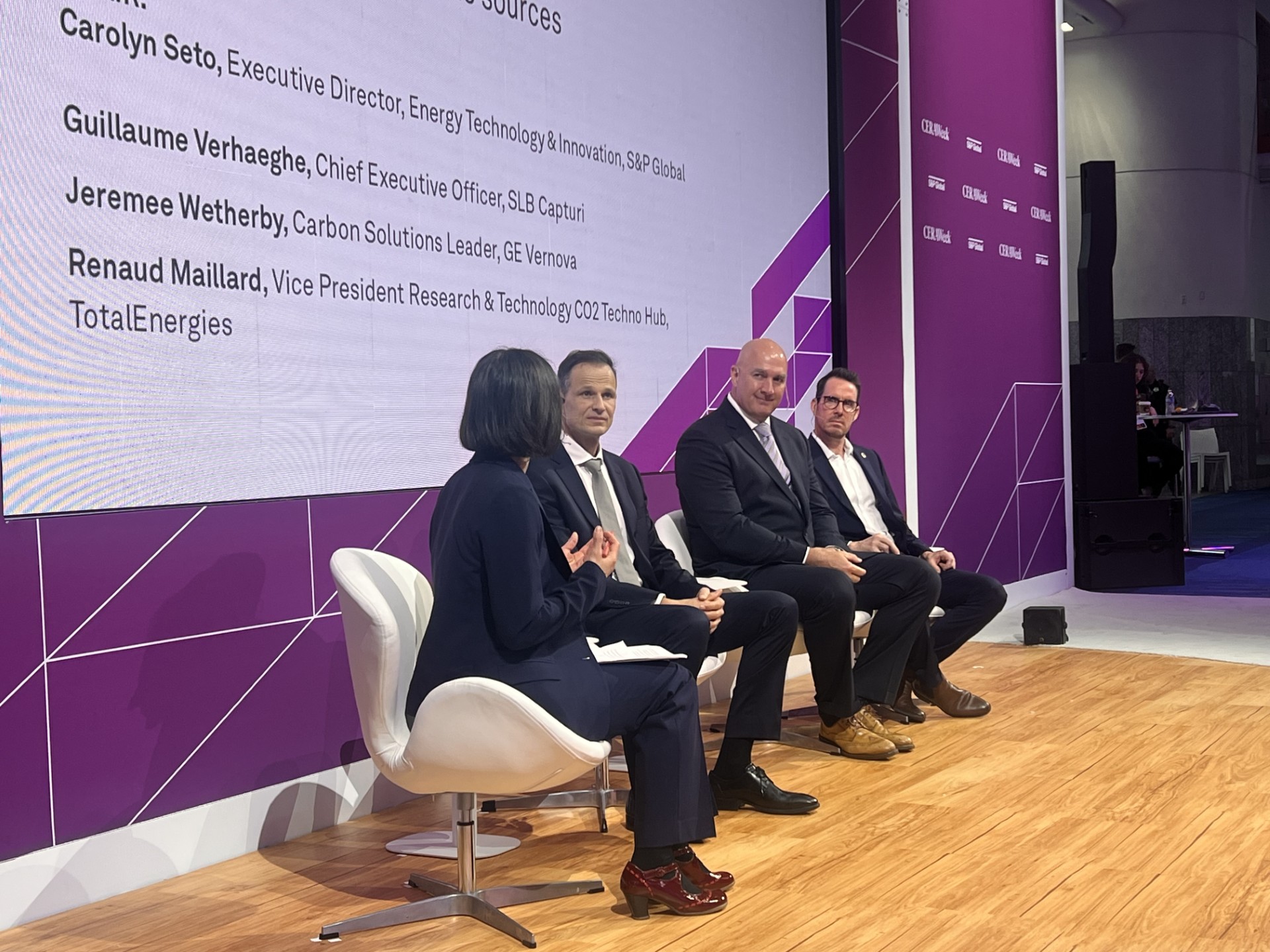
That was the key takeaway from a CCS-focused panel at the CERAWeek by S&P Global conference in Houston on March 24, where operators and technology providers said the industry’s biggest gains now come from how systems are designed and connected, not from new capture breakthroughs.
While global capacity remains far below where it needs to be, panelists said the core capture technologies themselves are already proven. The challenge is deploying them efficiently across complex industrial systems.
“Technology maturity… is not really a problem anymore,” Guillaume Verhaeghe, CEO of SLB Capturi, said.
Instead, the focus has shifted to reducing costs through better integration, particularly between capture units, power systems and downstream transport and storage.
Panelists pointed to system-level design as the biggest opportunity to improve project economics.
At GE Vernova, Jereme Wetherby said combining gas-fired power generation with capture systems is already delivering measurable gains. On the Net Zero Teesside project, integration between the power plant and capture facility allows shared use of steam and electricity, reducing both capital and operating costs.
New configurations are also improving capture efficiency. Wetherby highlighted exhaust gas recirculation technology, which redirects a portion of turbine exhaust back into the system. This both reduces the volume of gas sent to the capture unit and increases CO2 concentration, improving overall performance.
The result is a smaller, more efficient capture system with lower cost and reduced energy demand.
Interfaces Becoming the New Focus
TotalEnergies is approaching the problem from a different angle, focusing on how systems connect across the value chain.
Renaud Maillard said the company is prioritizing early coordination between emitters, capture providers and storage operators to avoid costly mismatches later in development.
That includes aligning specifications for flue gas, CO2 quality and system requirements before projects are fully designed.
The goal is to avoid what panelists described as one of CCS’s biggest risks: treating each part of the system independently, then trying to connect them later.
Developers are also balancing standardization with project-specific design.
SLB Capturi is pushing modular systems to reduce engineering time and construction risk, particularly for smaller-scale applications. But for large industrial projects, customization remains necessary to handle variations in flue gas composition and operating conditions.
Verhaeghe said the industry is moving toward a hybrid model, combining modular components with targeted engineering to optimize performance over the life of a project.
That tradeoff is critical, given that CCS projects are both capital-intensive and energy-intensive, making long-term efficiency gains essential to overall economics.
Another shift is toward designing assets that can adapt as technology improves.
Rather than waiting for next-generation capture technologies, panelists said developers are moving forward with current systems while building in flexibility to upgrade components over time.
This includes the ability to swap solvents, integrate new capture materials and modify system configurations without fully rebuilding facilities.
Panelists also pointed to emerging sorbent-based technologies, which could eventually allow capture systems to operate more like replaceable filter units. While still under development, these approaches could simplify future upgrades.