
Editor's Note: U.S. RNG Projects Expand as New Pipeline-Ready Supply Comes Online
By TYLER CAMPBELL, Editor-in-Chief
(P&GJ) — Renewable natural gas (RNG) is produced by capturing and purifying biogas from organic waste sources such as landfills, wastewater and agriculture. Rather than being released into the atmosphere or flared, the captured gas is converted into pipeline-quality fuel interchangeable with conventional natural gas.
To assist in the energy transition, RNG projects have gained a bit more traction in recent years. Toward the end of 2025, several projects were announced across the U.S. to replace traditional natural gas with RNG. For example, Noble Environmental has placed three new RNG facilities into commercial operation, expanding its landfill gas-to-pipeline portfolio across the Mid-Atlantic region. The plants process landfill gas, ensuring it is pipeline-quality RNG.
Also, toward the end of 2025, Nicor Gas announced its second RNG interconnection, linking WM’s Orchard Hills Landfill facility in Davis Junction, Illinois to its pipeline system. The project is expected to produce more than 5,926 million British thermal units (MMBtu) per day, which is enough to power about 18,000 homes.
In Florida, Nopetro and Johnson Controls partnered with Manatee County to develop a $50-MM RNG production facility that will convert landfill waste into clean fuel for trucks and buses. The facility will be operated by Nopetro and will turn captured methane from the Lena Road landfill into pipeline-quality RNG. The gas will be injected into existing infrastructure for west coast Florida customers.
Greenview Energy and Sparq Renewables have partnered with Reno County in Kansas to convert landfill methane into RNG, supplying pipeline-quality RNG to the local utility network. At full output, the facility will produce > 210,000 MMBtu/yr of RNG.
Finally, in Texas, Clean Energy Fuels has started injecting RNG into the pipeline from its $85-MM South Fork Dairy facility. The project is one of the nation's largest RNG facilities and processes 300,000 gallons of manure daily, generating millions of gallons of RNG per year.
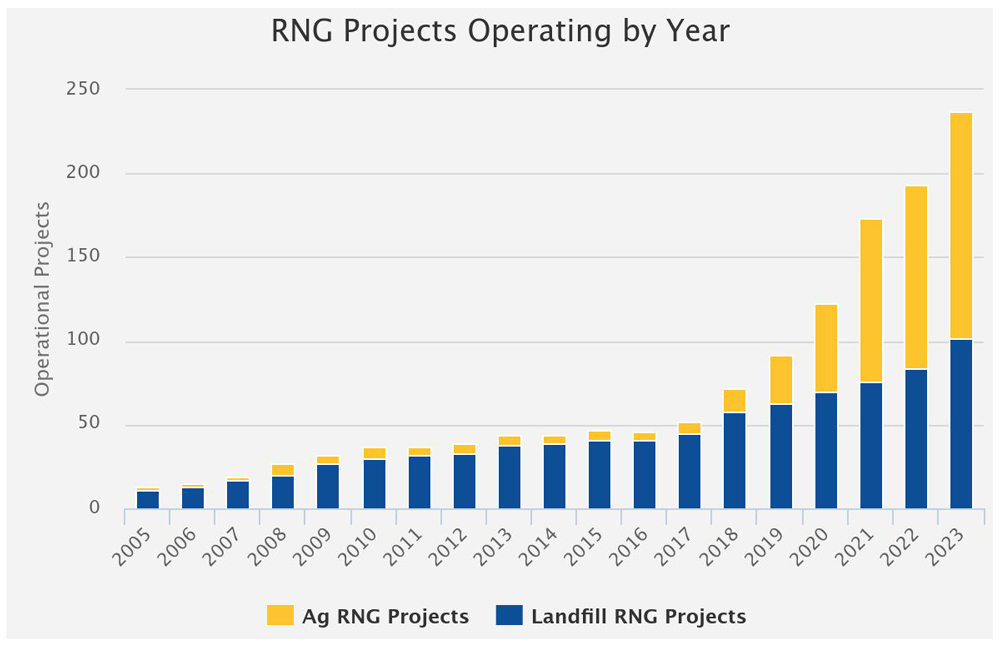
According to the U.S. Environmental Protection Agency (EPA), there were 11 landfill RNG projects operating in 2005, and 102 operating by 2023. That is a compound annual growth rate (CAGR) of 13.17% (FIG. 1).1 The number of landfill-based RNG projects in the U.S. has grown steadily over the past two decades, indicating that there is interest in converting methane from waste streams into pipeline-quality fuel. As utilities, municipalities and private developers invest in additional projects, RNG can play a role in diversifying energy supply while reducing methane emissions.
LITERATURE CITED
EPA, “Renewable natural gas,” January 2026, online: https://www.epa.gov/lmop/renewable-natural-gas#rngchart