

Texas Pipeline Projects to Lead U.S. Gas Capacity Growth
Texas is set to dominate new U.S. natural gas pipeline construction through 2027 as developers expand takeaway capacity from the Permian Basin to LNG export terminals and major demand markets.
(P&GJ) — Texas is expected to account for more than two-thirds of planned U.S. natural gas pipeline capacity additions scheduled for 2026 and 2027, according to the latest federal pipeline project data.
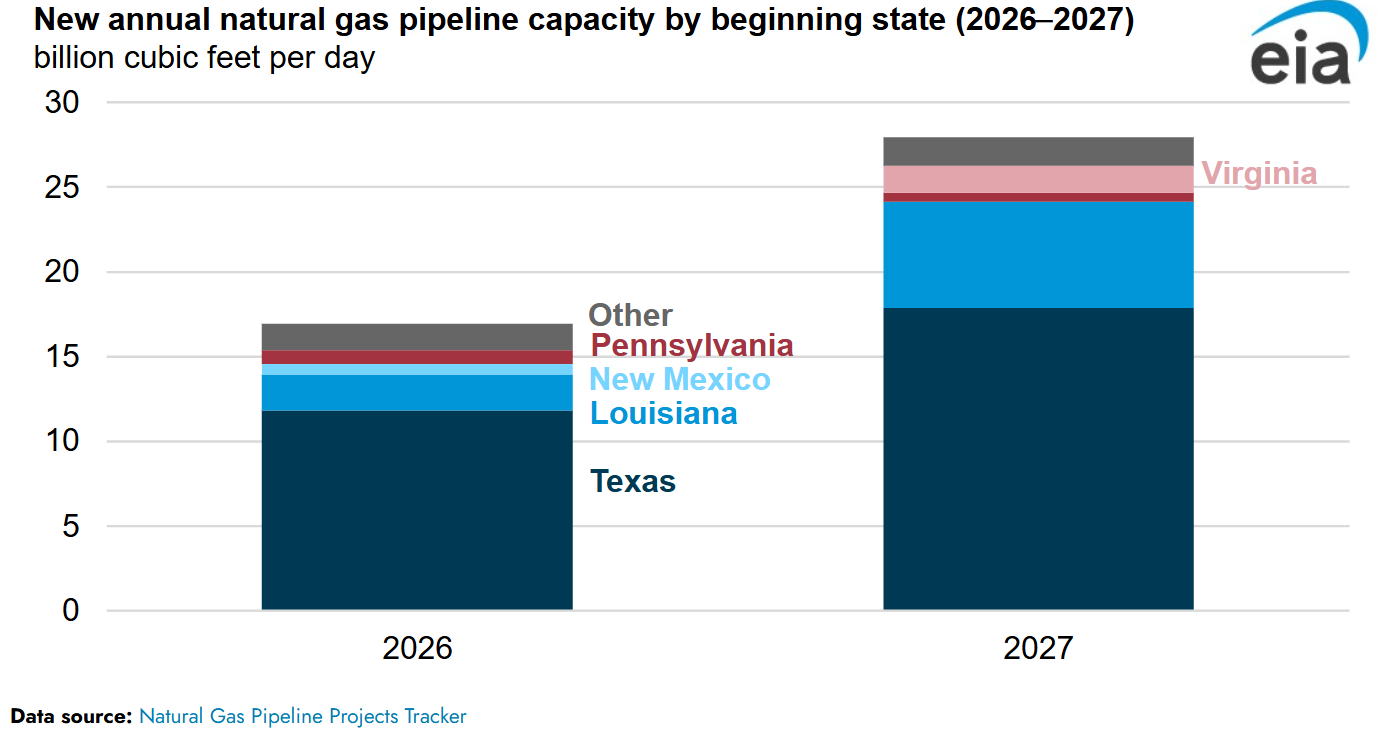
Developers plan to add about 44.9 billion cubic feet per day of new pipeline capacity nationwide over the two-year period, with roughly 31.6 billion cubic feet per day already under construction. Nearly 29.7 billion cubic feet per day of that capacity originates in Texas, largely tied to efforts to move growing Permian Basin production to LNG export terminals and downstream demand centers. Louisiana ranks second, with 8.4 billion cubic feet per day of planned additions.
Several major projects are expected to come online during the next two years, including the 4.5-billion cubic feet per day Rio Bravo Pipeline, which will supply feedgas to NextDecade’s Rio Grande LNG facility. The Blackcomb pipeline, designed to move Permian gas from the Waha Hub to Agua Dulce, is expected to add another 2.5 billion cubic feet per day of takeaway capacity when it enters service in 2026.
Developers are also advancing the Hugh Brinson Project in Texas, which is planned to add 2.2 billion cubic feet per day of Permian takeaway capacity in phases beginning in late 2026. In Louisiana, projects including the Port Arthur Pipeline Louisiana Connector and the Pelican Pipeline are expected to expand Gulf Coast gas transportation capacity tied to LNG demand growth.
Virginia is projected to see smaller but notable additions through Williams’ Southeast Supply Enhancement Project, an expansion of the Transcontinental Pipeline system extending from Virginia into Alabama.